Over the past two decades, grand schemes have advanced and receded for replacing New York's dreadful Penn Station. Robert W. Previdi offers four simpler, and achievable, solutions for improving the station's operations for its 440,000 daily users.


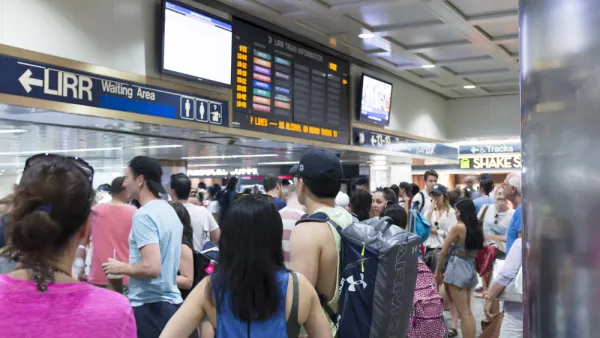
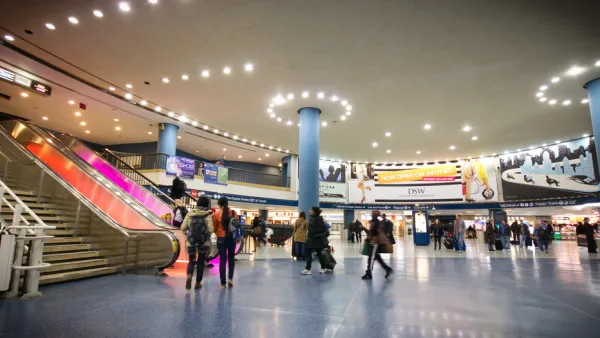
New York's City Council recently set a 10 year time limit for Madison Square Garden to vacate the roof of Penn Station, clearing the way for major renovations or replacement of the "claustrophobic maze". But why wait more than a decade for billions of dollars to be raised, agreements to be hammered out, and designs to be completed to improve the daily experience for users of the country's busiest train station, asks Robert W. Previdi, former spokesman and operations planner for New York City Transit. He offers four goals for improving the station in the interim.
"These goals — universal ticketing, access to all arrival and departure information, better signage throughout the station, a more engaging (and perhaps more profitable) retail experience — might seem obvious. The problem is that territorial claims within the station run deep."
"Moving Madison Square Garden someday sounds like a good idea. But running the station as one single transportation hub, not three, and focusing on assisting commuters and travelers in navigating the warren that is Penn Station will result in streamlined operations and a more pleasant commuting experience — even without moving Madison Square Garden or expanding tunnel capacity between New York and New Jersey," he concludes.
Read the full story: Fixing Penn Station Without Rebuilding It
Historic Preservation Appeal Could Delay Penn Station Redevelopment
New York State's Historic Preservation Office has moved to place the notorious Penn Station on the National Register of Historic Places, potentially upending redevelopment plans.

In New York's Next Penn Station, Function Does Not Always Follow Form
Some of the time and money invested in the visually spectacular Moynihan Station should have been spent looking at how well it actually works for commuters, writes Alon Levy.
Cuomo Has a Unique Opportunity with Penn Station
The disastrous state of the country's most busy transit station presents an opportunity to make big improvements.

Planetizen Federal Action Tracker
A weekly monitor of how Trump’s orders and actions are impacting planners and planning in America.

California plans to bury El Niño’s downpour
If the state plays its cards right, it may be able to store a billion acre-feet of El Niño’s water in aquifers.

Desperate measures: Advocates weigh draining Lake Powell to fill Colorado River
Draining the reservoir could reduce evaporation losses by a couple hundred thousand acre-feet.

Los Angeles just elected an urban planner as its mayor
Transportation analysts are optimistic that Raman will be more aggressive in addressing transit issues than Bass.

Mamdani’s pied-à-terre tax survives legal challenge
A panel of judges found that the plaintiffs failed to demonstrate injury as a result of New York City's implementation of the tax.

Eastern Nebraska is running out of electricity
Data centers and electrification are straining eastern Nebraska’s grid, throttling economic development.

FREE Course: Walkable City 1: Why Walkability?
After describing his path towards focusing on walkability as the essence of good planning, Jeff Speck marches through his five principal reasons for making more walkable places.
Reinventing Malls: Planning Alchemy—Turning Gray Fields Into Gold
The course focuses on the opportunities and imperatives that shape reinvention of mall sites.

City of Rosemead
Rutgers University, Edward J. Bloustein School of Planning and Public Policy
One Hundred Miles
University of Michigan School for Environment and Sustainability (SEAS)
Hunter College, City University of New York (CUNY)
The Architects Foundation
City of Cambridge
Montrose County
The Pocatello Development Authority