Marseille has sought to maximize its year as European Cultural Capital to jumpstart a transformation of the notoriously rough-and-tumble port city. But will new initiatives provide enough momentum to dislodge old habits and stereotypes?


"Thanks to European Cultural Capital initiative, Marseille-Provence 2013, which will dump a projected €98,000,000 into the city by the end of the year, its cultural scene leads the charge for Marseille to be the thinking-person’s destination on the Med," writes Alexander Forbes.
Despite the construction of a host of new museums, ambitious architecture, and high profile public spaces, obstacles to the city's rebirth as a "vibrant Mediterranean capital" remain.
"Institutions aside, habits such as the population’s love for the automobile despite the city center’s fairly walkable scale, a recently revamped public transport system, and constant lack of parking leave a lack of street life aside from the most touristy areas directly surrounding the Vieux Port. It’s a point-a-to-point-b kind of place, not one in which to find your next café or bar by stroll and one in which you might spend triple the time driving to that next spot as you might have walking the kilometer or two."
Read the full story: A Walk in Marseille: Will a Once-Rough City's Cultural Makeover Take?

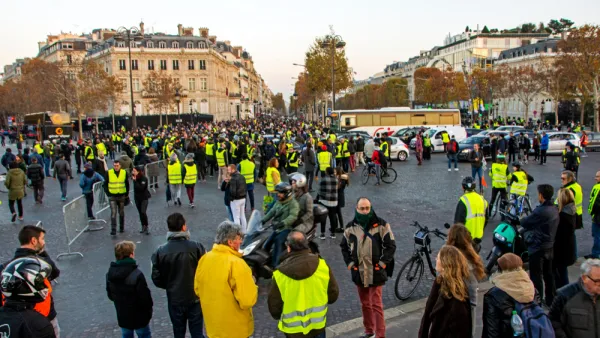
France Drops Road Tolling Plans Amid Fuel Tax Protests
Controversial London-style congestion pricing won't be coming to French cities due to concerns sparked by the 'Yellow Vest' protests over an upcoming fuel tax hike, but President Macron stated the fuel tax increases will go forward in January.
New Pavilion Reflects Marseille's Revitalization
A sleek new pavilion made of reflective stainless steel, designed by Foster + Partners, is helping to reshape the image of France's rough-and-tumble port city as a destination.

Planetizen Federal Action Tracker
A weekly monitor of how Trump’s orders and actions are impacting planners and planning in America.

‘Going backwards:’ Baltimore mayor, students rally against state's transit funding plan
Maryland's proposed six-year plan provides no funding for Baltimore’s BMORE bus program and reduces its road maintenance funding.

Detroit to transform waterfront with $2.2 billion investment
Developers will convert about 18 acres of unused parking lot space into civic spaces.

U.S.-Iran war may have ‘devastating’ impact on cost to warm homes
Vermont and Maine residents may see a 76% increase in the cost of warming their homes this winter.

Senate bill would ‘overhaul’ environmental permitting laws
Under the proposed act, government agencies would also not be able to suspend or rescind permits after granting them.

Exemption applications for NYC’s pied-à-terre tax see 55% success rate
The city sent nearly 40% of its initial pied-à-terre tax warnings erroneously.

FREE Course: Walkable City 1: Why Walkability?
After describing his path towards focusing on walkability as the essence of good planning, Jeff Speck marches through his five principal reasons for making more walkable places.
Reinventing Malls: Planning Alchemy—Turning Gray Fields Into Gold
The course focuses on the opportunities and imperatives that shape reinvention of mall sites.

One Hundred Miles
County of Mendocino
planning NEXT
The Architects Foundation
University of Cincinnati Online
Montrose County
Northern Illinois Transit Authority (NITA)
The Pocatello Development Authority