A sleek new pavilion made of reflective stainless steel, designed by Foster + Partners, is helping to reshape the image of France's rough-and-tumble port city as a destination.


Kyle VanHemert discusses the new Vieux Port pavilion in Marseille, "a thousand-square-meter piece of strikingly reflective stainless steel" that's been erected alongside the historic harbor in time for the city's turn as a European Capital of Culture for 2013.
As Steven Erlanger and Maia de la Baume noted recently in The New York Times, "[the title] gives Marseille, France’s second-largest city, a chance to remake itself, reclaim its gorgeous port for ordinary citizens and to reshape its image — from a poor, rough, crime-ridden and corrupt crossroads whose economy declined with the end of colonialism to an attractive tourist destination of sun, sea, seafood and culture." And the pavilion certainly looks like a tourist magnet, in the same vein as Chicago's Cloud Gate sculpture.
"The design--that single, ultra-thin stainless steel surface, held up by eight unadorned pillars--is a stroke of simple brilliance," says VanHemert. "For those approaching or just passing by, the pavilion will be nearly invisible, which is a good thing--the harbor, a World Heritage site, deservedly remains the star of the show. But up close, the hovering mirror both transforms and expands the space. It can direct pedestrians’ gazes back out to the sea, or allow them to inspect their own reflections overhead, essentially making them part of the landscape."
Read the full story: That’s what the new Vieux Port pavilion in Marseille offers, reflecting the city’s historic harbor with a thousand-square-meter
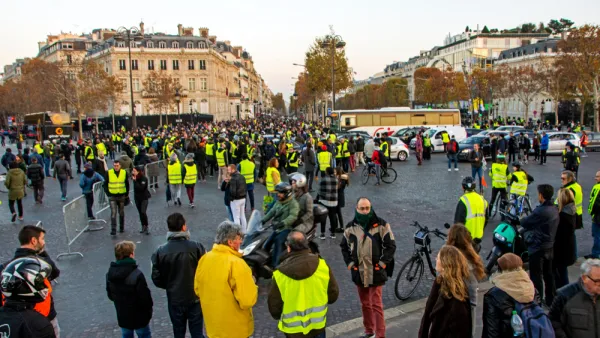
France Drops Road Tolling Plans Amid Fuel Tax Protests
Controversial London-style congestion pricing won't be coming to French cities due to concerns sparked by the 'Yellow Vest' protests over an upcoming fuel tax hike, but President Macron stated the fuel tax increases will go forward in January.
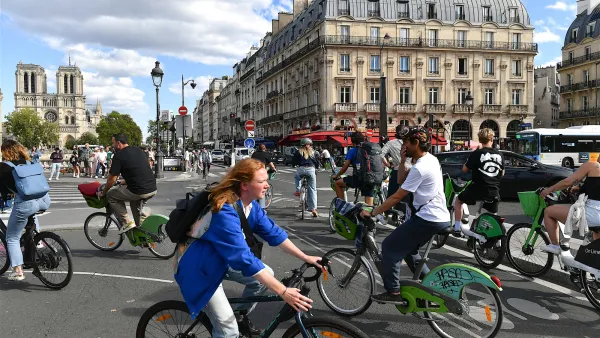
Biking in Paris grew by 240% in 5 years
The city saw a significant rise in bike use thanks to data-driven policy changes.
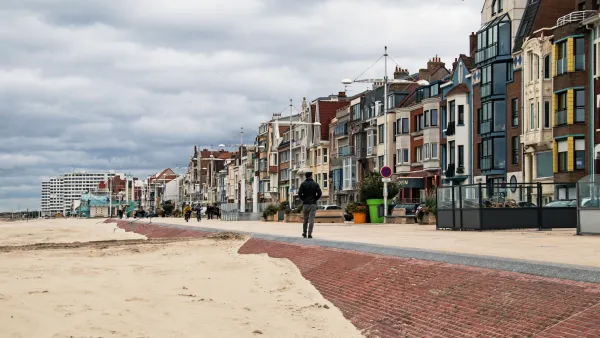
The City Where Free Buses Changed Everything
New York’s new mayor Zohran Mamdani has said he’ll make every bus free to ride. This French city did just that — and is reaping the rewards.

Planetizen Federal Action Tracker
A weekly monitor of how Trump’s orders and actions are impacting planners and planning in America.

California plans to bury El Niño’s downpour
If the state plays its cards right, it may be able to store a billion acre-feet of El Niño’s water in aquifers.

Desperate measures: Advocates weigh draining Lake Powell to fill Colorado River
Draining the reservoir could reduce evaporation losses by a couple hundred thousand acre-feet.

Mamdani’s pied-à-terre tax survives legal challenge
A panel of judges found that the plaintiffs failed to demonstrate injury as a result of New York City's implementation of the tax.

Eastern Nebraska is running out of electricity
Data centers and electrification are straining eastern Nebraska’s grid, throttling economic development.

Seattle passes record-breaking transit services expansion
Proposition 1 will double the city’s transit tax to add 95,000 more bus trips and preserve 180,000 bus trips annually.

FREE Course: Walkable City 1: Why Walkability?
After describing his path towards focusing on walkability as the essence of good planning, Jeff Speck marches through his five principal reasons for making more walkable places.
Reinventing Malls: Planning Alchemy—Turning Gray Fields Into Gold
The course focuses on the opportunities and imperatives that shape reinvention of mall sites.

City of Rosemead
Rutgers University, Edward J. Bloustein School of Planning and Public Policy
One Hundred Miles
University of Michigan School for Environment and Sustainability (SEAS)
Hunter College, City University of New York (CUNY)
The Architects Foundation
City of Cambridge
Montrose County
The Pocatello Development Authority