As Director of Public Policy at Airbnb, Molly Turner has noticed she's the only planner in attendance at the Bay Area's myriad hackathons and conferences. As tech increasingly addresses urban issues, is it doomed to repeat planning's past mistakes?


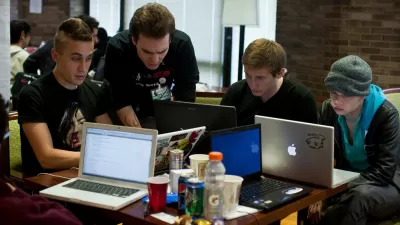
"Here in urban Silicon Valley — and especially in San Francisco — the tech community has begun wading into the realm of urban planning, oftentimes without even realizing it," says Turner. "As an urban planner moonlighting in tech, I’ve been invited to hackathons and conferences,TEDx talks and prototyping festivals — all focused on critical urban issues ranging from homelessness to economic development, public art to public transportation. Through all of these events I’ve noticed one commonality: I’m the only urban planner there."
Why is this a problem? "[T]ech innovators also like to work on a tavola raza, void of constraints, preconceived obstacles or even the benefit of institutional knowledge," she explains. "And while sometimes that leads to genius strokes of ingenuity, other times it means unknowingly repeating mistakes of our urbanist past, such as becoming overly reliant on the wisdom of the crowd or failing to account for important social or cultural divides."
"That is precisely why tech innovators and planners have much to learn from each other. Technological solutions should better account for the complexities of urban ecosystems, and planning solutions should better pace themselves for incremental implementation."
Read the full story: Letter from San Francisco: On Being an Urban Planner in the Tech World

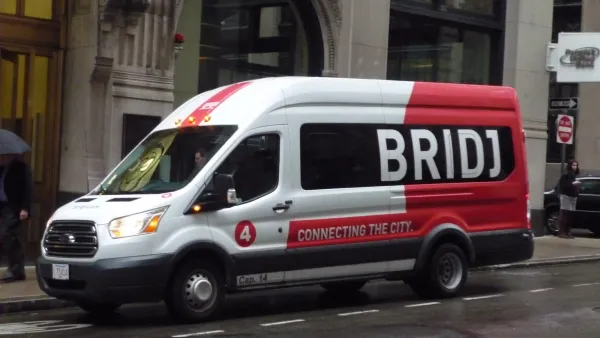
Bridj Comes to a Halt
Bridj's bet that it could, well, bridge ride-hailing and public transit didn't pay off. Lacking new investment, the company is shutting down.

Children in 55 countries are redesigning their cities in Minecraft
A U.N.-backed program lets students and community members reimagine sites in their neighborhoods in the game — and translate them into real-life buildings.

5 ways to hallucination-proof your AI output
With public trust on the line, the stakes are high for urban planners to ensure accuracy in our AI work. Here’s how to do it.

Planetizen Federal Action Tracker
A weekly monitor of how Trump’s orders and actions are impacting planners and planning in America.

Amtrak, CN end decades-long dispute with eight-year agreement
The new operating agreement establishes an updated framework for the companies to work together, including processes to resolve disputes.

Judges permit Denver to divert 77,000 acre feet from the Colorado River for reservoir expansion
Overuse and climate change have caused the Colorado River’s water levels to plummet.

NYC DOT wants faster, more permanent street upgrades
The city is examining ways to build more concrete infrastructure without getting entangled in 'decades-long' projects.

'Something we’ve never seen before:' rising utility rates could strain city finances nationwide
Data centers, climate change and other factors have caused utility rates in the United States to increase by 38% since 2020.

Trump to overrule local leaders, lease millions of acres of America’s Pacific Island territories’ seafloors to mining companies
International law says that the Indigenous people of America’s territories have a right to prior and informed consent regarding projects that impact their countries.

FREE Course: Walkable City 1: Why Walkability?
After describing his path towards focusing on walkability as the essence of good planning, Jeff Speck marches through his five principal reasons for making more walkable places.
Reinventing Malls: Planning Alchemy—Turning Gray Fields Into Gold
The course focuses on the opportunities and imperatives that shape reinvention of mall sites.

Harvard University Graduate School of Design
KFH Group Inc.
Greater Baltimore Committee
The Architects Foundation
University of Cincinnati Online
The Pocatello Development Authority
The Urban Renewal Agency of the City of Pocatello