The federal government has a role to play in the financial crises afflicting cities across America, and most notably of late, in Detroit. Should Washington also play a role in helping them to recover?


"America’s urban communities—and many not-so-urban communities—have for decades been battered by free-trade policies that foster deindustrialization, by tax policies that encourage offshoring, by all the missteps and misdeeds of Congress and successive presidents," says John Nichols. "Washington did plenty to create the crisis. Yet, as Michigan Congressman Dan Kildee notes, 'For too long lawmakers and regulators have stood aside as cities grapple with budget deficits, unfunded pensions and crumbling infrastructure.'”
As it did when the country's largest banks and automakers faced collapse, "[c]ommon sense says that the federal government, which has played a part in undermining the economic prospects of American cities, needs to start playing a useful role," he argues.
"To this end, President Obama and serious members of Congress must speak up about the vital importance of federal interventions not merely on behalf of cities but also on behalf of the people who live in major municipalities that cannot be allowed to fail."
Read the full story: Cities Really Are Too Big to Fail

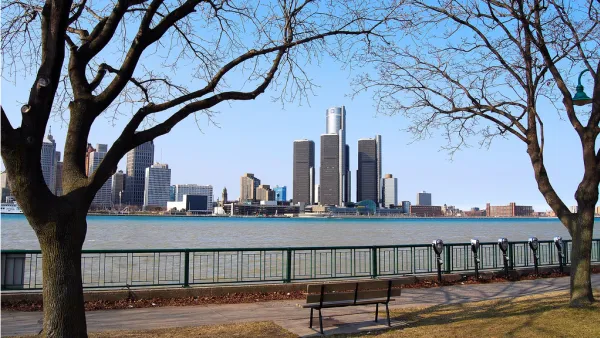
Detroit Still a Long Way from Recovery
It's fun to write miracle comeback stories, but the epic of Detroit's resurgence has been exaggerated, according to an article in The Conversation.
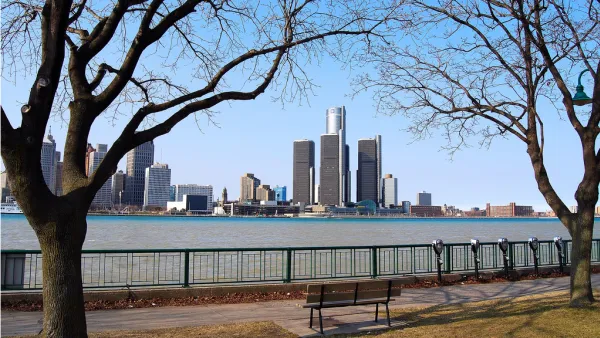
Lessons from Masterminds of Detroit's Rebirth
The enthusiasm of Detroit's new civic leadership, who engineered its bankruptcy and set up its recovery, is infectious. How the city will ultimately fare, and how other troubled cities learn from Detroit's mistakes, remains to be seen.
Judge Allows Detroit Bankruptcy to Proceed
U.S. Bankruptcy Judge Steven Rhodes ruled today that the city of Detroit is eligible for bankruptcy protection, allowing the city to proceed with the largest municipal bankruptcy in U.S. history. Public employee unions are expected to appeal.

Planetizen Federal Action Tracker
A weekly monitor of how Trump’s orders and actions are impacting planners and planning in America.

California plans to bury El Niño’s downpour
If the state plays its cards right, it may be able to store a billion acre-feet of El Niño’s water in aquifers.

Chicago breaks ground on $3 billion megadevelopment
The new neighborhood, titled Foundry Park, will one day host 3,700 residences.

California High-Speed Rail Authority CEO resigns after $600,000 scandal
Under Ian Choudri, the authority used taxpayer dollars to fund first class flights and trips to nightclubs.

Want to study the Missouri River? Soon, you may need unanimous approval from 10 states
Legislation would require 10 governors’ permission to study or build projects moving water outside the basin.

Desperate measures: Advocates weigh draining Lake Powell to fill Colorado River
Draining the reservoir could reduce evaporation losses by a couple hundred thousand acre-feet.

FREE Course: Walkable City 1: Why Walkability?
After describing his path towards focusing on walkability as the essence of good planning, Jeff Speck marches through his five principal reasons for making more walkable places.
Reinventing Malls: Planning Alchemy—Turning Gray Fields Into Gold
The course focuses on the opportunities and imperatives that shape reinvention of mall sites.

City of Rosemead
Rutgers University, Edward J. Bloustein School of Planning and Public Policy
One Hundred Miles
Hunter College, City University of New York (CUNY)
The Architects Foundation
University of Cincinnati Online
City of Cambridge
Montrose County
The Pocatello Development Authority