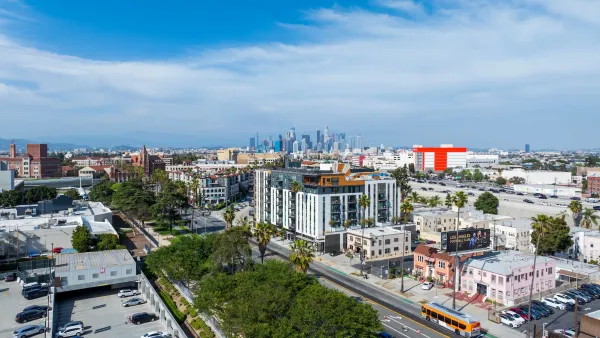
Small-lot homes are popping up in the hillsides north of downtown L.A. While the new occupants, often young buyers who can't afford or aren't interested in traditional single-family homes and high-rise condos, are pleased, some neighbors are not.


Real estate reporter Andrew Khouri writes that new "skinny homes on tiny lots are sprouting from the hillsides — a building boom of miniature proportions."
The rectangular structures come in clusters of six or 15, or even 70, and developers are racing to build them in trendy Silver Lake and Echo Park. They're eyeing younger home buyers who crave hip cafes and proximity to work but don't want a sky-high condo or a Craftsman bungalow.
Although the "skinny" homes won't be cheap, they'll be more affordable than traditional single-family homes in the city's pricey neighborhoods.
In Silver Lake, developer Trumark Homes hopes to break ground this summer on 70 small-lot, three-story homes with no backyards, most with rooftop decks. Trumark plans to sell them early next year for between $575,000 and $635,000.
Khouri writes that the "so-called small-lot homes speak to a growing desire for a more compact and walkable Los Angeles, while still clinging to the single-family ideal." But not all are happy.
The homes have their critics, said Jesus Sanchez, founder of the popular neighborhood blog the Eastsider LA, about Echo Park and surrounding areas. Some complain that the clustered homes could spoil the character of a neighborhood characterized by older hillside homes and spacious backyards.
Will the cluster homes help shape the future of Los Angeles, and towards what end?
Architect Christian Návar, whose company has designed many of the new developments, "sees the compact homes as a chance to inject more homeowners into walkable neighborhoods, who will in turn support more businesses. Their popularity, he said, is evidence of a younger generation that wants to live more efficiently."
Read the full story: In urban L.A., developers are building trendy homes on tiny lots


Changes to Los Angeles' Small Lot Ordinance on the Way
Responding to criticism from neighborhoods faced with new small lot developments, the city of Los Angeles in considering changes to its Small Lot Subdivision Ordinance.
New Small Lot Housing Development in L.A. Asks: 'How Dense Can You Go?'
An enterprising developer and experimental architect are pushing the boundaries between L.A.'s suburban style of single-family housing and its need for dense infill development on a site in the city's Echo Park neighborhood.
LA delays state housing mandate with 'low-rise ordinance'
The new ordinance allows the city to delay implementing SB 79, a state law requiring more density near transit.

Planetizen Federal Action Tracker
A weekly monitor of how Trump’s orders and actions are impacting planners and planning in America.

Amtrak, CN end decades-long dispute with eight-year agreement
The new operating agreement establishes an updated framework for the companies to work together, including processes to resolve disputes.

Judges permit Denver to divert 77,000 acre feet from the Colorado River for reservoir expansion
Overuse and climate change have caused the Colorado River’s water levels to plummet.

Philadelphia to invest $2 billion into upgrading city airports as PHL places last in customer satisfaction
Modernizations to Philadelphia's airports will include baggage system upgrades and a new automated parking garage guidance system.

The LA housing policies making developers turn away from the city
Despite LA’s housing shortage, developers say the city’s "mansion-tax" and pandemic-era policies make it an unappealing place to build housing.

New density bill would require 7 California cities to establish regional transit hubs
The bill would also require major cities in California to permit high-rise residential buildings.

FREE Course: Walkable City 1: Why Walkability?
After describing his path towards focusing on walkability as the essence of good planning, Jeff Speck marches through his five principal reasons for making more walkable places.
Reinventing Malls: Planning Alchemy—Turning Gray Fields Into Gold
The course focuses on the opportunities and imperatives that shape reinvention of mall sites.

City of Wisconsin Rapids
Harvard University Graduate School of Design
KFH Group Inc.
The Architects Foundation
University of Cincinnati Online
The Pocatello Development Authority
The Urban Renewal Agency of the City of Pocatello