Spotted on the front page of Saturday's WSJ is a picture of a Yuba Mundo longtail cargo bike, directing readers to Tom Vanderbilt's feature article of the "Off Guard" section describing the many types of cargo bikes. Main cargo is kids and groceries.


Vanderbilt describes all types of cargo bikes, "a catch-all term covering a variety of bike styles built for functional hauling" including Copenhagen's "Long John" with it's bakfiet (Dutch for box) container in the front; the Xtracycle "that kicked the whole thing off" in 1998; its predecessor, the Ho Chi Minh bike; and the $2,000 Milano.
"But for various reasons—better price, the perception that they ride a bit more like "regular" bikes—it's the less unusual looking longtail cargo bike (pictured above is a Yuba model) that has taken hold on American soil", Vanderbilt writes.
While commonplace in Copenhagen, cargo bikes are just now becoming more commonplace in American cities. Ross Evans, founder of Xtracycle in 1998 and who plays a key role in bringing the cargo bike to the U.S., links the popularity of the bike to another American, urban innovation.
He said its growth roughly parallels the rise of farmers' markets. "It is the perfect farmers' market bike".
Cargo bike trivia: "The country's biggest seller of the Yuba Mundo is Joe Bike, a Portland, Ore., store specializing in "high-performance urban, utility and touring bikes", according to Vanderbilt.
Did the Wall Street Journal whet your appetite for a cargo bike? Why not check out a review (and video) of cargo bikes in Bicycling Magazine?
Tom Vanderbilt, author of "Traffic: Why We Drive The Way We Do (and What It Says About Us) and Survival City", is a prolific writer on transportation issues, many of which can be found here.
Contributor's note: Link to the article for those without Wall Street Journal subscription may not provide full access after July 13.
Read the full story: Cargo Bikes: The New Station Wagon


Copenhagen is losing its cool
In a city long designed to maximize light during dark Scandinavian winters, climate change is forcing the Danish capital to rethink its relationship with the sun.

Amazon launches cargo bike deliveries in DC
The e-commerce giant is deploying micromobility devices including cargo bikes and mopeds in several global markets to reduce the need for larger trucks and vans for last-mile deliveries.
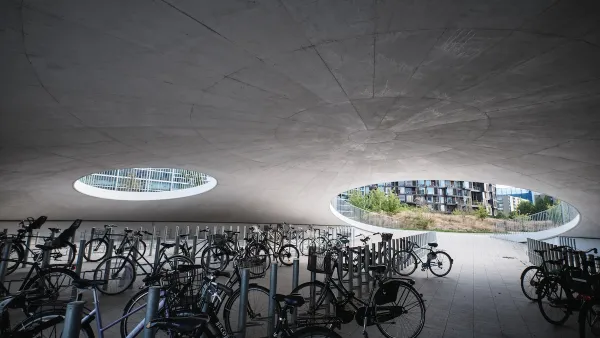
How Copenhagen Became a ‘Sponge City’
The Danish capital is implementing a massive, multi-pronged strategy to build resilience against flooding and shore up water supplies during drought periods.

Planetizen Federal Action Tracker
A weekly monitor of how Trump’s orders and actions are impacting planners and planning in America.

Amtrak, CN end decades-long dispute with eight-year agreement
The new operating agreement establishes an updated framework for the companies to work together, including processes to resolve disputes.

Judges permit Denver to divert 77,000 acre feet from the Colorado River for reservoir expansion
Overuse and climate change have caused the Colorado River’s water levels to plummet.

NYC DOT wants faster, more permanent street upgrades
The city is examining ways to build more concrete infrastructure without getting entangled in 'decades-long' projects.

'Something we’ve never seen before:' rising utility rates could strain city finances nationwide
Data centers, climate change and other factors have caused utility rates in the United States to increase by 38% since 2020.

Trump to overrule local leaders, lease millions of acres of America’s Pacific Island territories’ seafloors to mining companies
International law says that the Indigenous people of America’s territories have a right to prior and informed consent regarding projects that impact their countries.

FREE Course: Walkable City 1: Why Walkability?
After describing his path towards focusing on walkability as the essence of good planning, Jeff Speck marches through his five principal reasons for making more walkable places.
Reinventing Malls: Planning Alchemy—Turning Gray Fields Into Gold
The course focuses on the opportunities and imperatives that shape reinvention of mall sites.

Harvard University Graduate School of Design
KFH Group Inc.
Greater Baltimore Committee
The Architects Foundation
University of Cincinnati Online
The Pocatello Development Authority
The Urban Renewal Agency of the City of Pocatello