As more governments embrace civic hackathons as a way to tap enthusiastic young software developers quickly and cheaply, a backlash to these "app-developing marathons" is growing along with them. Does their local focus doom them to irrelevance?


"We've heard the argument before that hackathons aren't all they're cracked up to be, even that they're downright bad for you," says Emily Badger. "Now the critique, in particularly blunt language, is coming from [Bill Schrier] the former chief technology officer of the tech-friendly city of Seattle."
"Schrier argues, in short, that most local apps developed in hackathons and contests are unsustainable because they can't be be monetized or scaled up to other cities. The two problems, as Schrier points out, are closely related."
"Without standardized data, a great app built in one city won't function anywhere else," explains Badger. "But more importantly – and this is Schrier's most compelling point – no one will make real money off of this stuff until 'data is standardized so a single app – a crime reporting app, for example – can be downloaded and used across an entire state or the nation with the potential for millions of users.'"
Read the full story: Are Civic Hackathons Stupid?


Best Apps for Urban Planning in 2022
Mobile apps continue to redefine the practices of planning—urban planning, regional planning, transportation planning, community planning, and rural planning included.
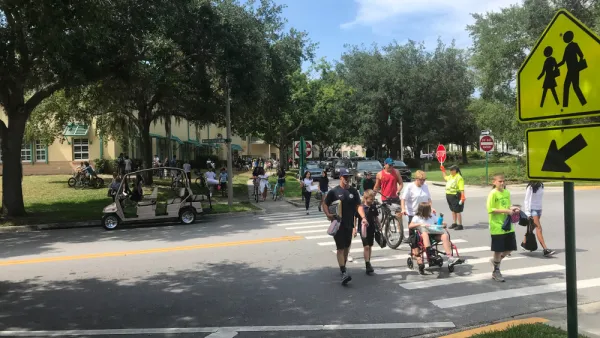
Earn Rewards for Traveling for by Foot, Bike, Bus, or Train
The city of Orlando is partnering with the Miles app.
A New App Helps Identify 15-Minute City
The new 15-Minute City App generates maps which show the number of services and activities within a 15 minute walk, and and therefore whether an area can be considered a 15-minute neighborhood.

Planetizen Federal Action Tracker
A weekly monitor of how Trump’s orders and actions are impacting planners and planning in America.

Amtrak, CN end decades-long dispute with eight-year agreement
The new operating agreement establishes an updated framework for the companies to work together, including processes to resolve disputes.

Judges permit Denver to divert 77,000 acre feet from the Colorado River for reservoir expansion
Overuse and climate change have caused the Colorado River’s water levels to plummet.

NYC DOT wants faster, more permanent street upgrades
The city is examining ways to build more concrete infrastructure without getting entangled in 'decades-long' projects.

'Something we’ve never seen before:' rising utility rates could strain city finances nationwide
Data centers, climate change and other factors have caused utility rates in the United States to increase by 38% since 2020.

Trump to overrule local leaders, lease millions of acres of America’s Pacific Island territories’ seafloors to mining companies
International law says that the Indigenous people of America’s territories have a right to prior and informed consent regarding projects that impact their countries.

FREE Course: Walkable City 1: Why Walkability?
After describing his path towards focusing on walkability as the essence of good planning, Jeff Speck marches through his five principal reasons for making more walkable places.
Reinventing Malls: Planning Alchemy—Turning Gray Fields Into Gold
The course focuses on the opportunities and imperatives that shape reinvention of mall sites.

Harvard University Graduate School of Design
KFH Group Inc.
Greater Baltimore Committee
The Architects Foundation
University of Cincinnati Online
The Pocatello Development Authority
The Urban Renewal Agency of the City of Pocatello