As substantial state and federal subsidies for electric cars continue, and the number of vehicles on America's roads climbs, a new article is raising questions about their environmental benefits over conventional cars.


"In an article published in Spectrum, the news arm of the Institute for Electrical and Electronics Engineers, [Ozzie] Zehner notes that researchers have come to some widely divergent conclusions [about the environmental benefits of electric vehicles]," writes Angie Schmitt.
"Industry-funded research tends to paint a rosy picture of how electric cars, powered by clean fuels, will curb carbon emissions, Zehner writes. He cites electric vehicle research from Stanford University’s Global Climate & Energy Project, which has received $113 million from ExxonMobil, General Electric, Schlumberger, and Toyota."
"Once you take into account the full life cycle of the vehicles and environmental costs in addition to carbon emissions, electric cars look a lot less green," she adds. "Zehner refers to a life cycle analysis by the National Academies that considered the full environment costs of electric cars, including the manufacture and disposal of their batteries, which found no benefit compared to conventional cars."
Read the full story: The Exaggerated Benefits of Electric Cars

Swapping your gas car for an EV is greener than keeping it, research shows
An EV repays the 'carbon debt' caused by building it after 4,400 miles.
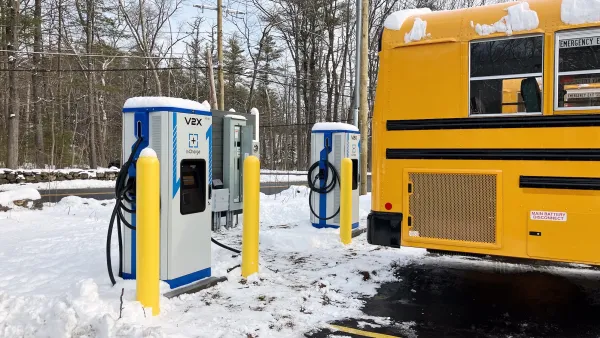
Massachusetts program pays EV owners to put power back into the grid
A pilot program could pave the way for more vehicle-to-grid installations in the United States.
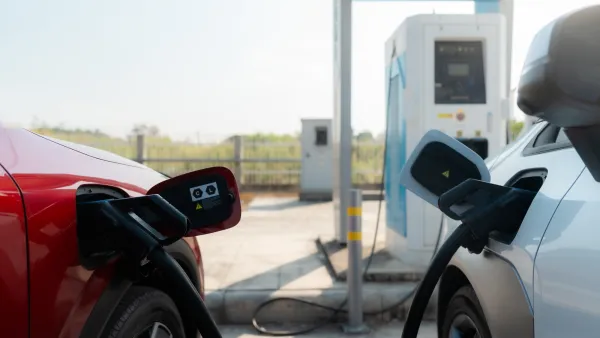
California launches $3,500 EV rebate
A new rebate program aims to maintain momentum for EV adoption as the federal government eliminates other incentives.

Planetizen Federal Action Tracker
A weekly monitor of how Trump’s orders and actions are impacting planners and planning in America.

California plans to bury El Niño’s downpour
If the state plays its cards right, it may be able to store a billion acre-feet of El Niño’s water in aquifers.

Desperate measures: Advocates weigh draining Lake Powell to fill Colorado River
Draining the reservoir could reduce evaporation losses by a couple hundred thousand acre-feet.

In Texas, data centers are swallowing promised parkland
Residents who moved to Taylor, Texas for a rural community now have to contend with three data centers in their backyard.

How a Chicago-sized wind farm beat the odds and powered on
The project spanned five presidential administrations and a standoff with a U.S. military base.

MTA gives itself 30 days to transform pit into basketball court
The site has been under construction since 2022; the city originally estimated it would finish the court in 2024.

FREE Course: Walkable City 1: Why Walkability?
After describing his path towards focusing on walkability as the essence of good planning, Jeff Speck marches through his five principal reasons for making more walkable places.
Reinventing Malls: Planning Alchemy—Turning Gray Fields Into Gold
The course focuses on the opportunities and imperatives that shape reinvention of mall sites.

City of Rosemead
Rutgers University, Edward J. Bloustein School of Planning and Public Policy
One Hundred Miles
Hunter College, City University of New York (CUNY)
The Architects Foundation
University of Cincinnati Online
City of Cambridge
Montrose County
The Pocatello Development Authority