President Obama recently unveiled his 21-page framework for tackling climate change. But for some economists, that's twenty pages too many. A tax on carbon emissions is a simple, elegant, and relatively painless way to reduce emissions, they believe.


"Climate change seems like this complicated problem with a million pieces," says David Kestenbaum. "But Henry Jacoby, an economist at MIT's business school, says there's really just one thing you need to do to solve the problem: Tax carbon emissions."
"'If you let the economists write the legislation,' Jacoby says, 'it could be quite simple.' He says he could fit the whole bill on one page."
"Basically, Jacoby would tax fossil fuels in proportion to the amount of carbon they release," explains Kestenbaum. "That would make coal, oil and natural gas more expensive. That's it; that's the whole plan."
"This is why economists love a carbon tax: One change to the tax code and the entire economy shifts to reduce carbon emissions. No complicated regulations. No rules for what kind of gas mileage cars have to get or what specific fraction of electricity has to come from wind or solar or renewables. That's by and large the way we do it now."
Read the full story: Economists Have A One-Page Solution To Climate Change


Washington Voters Keep Carbon Tax
An initiative that would have ended the state’s “cap and invest” program failed, leaving the program in place.
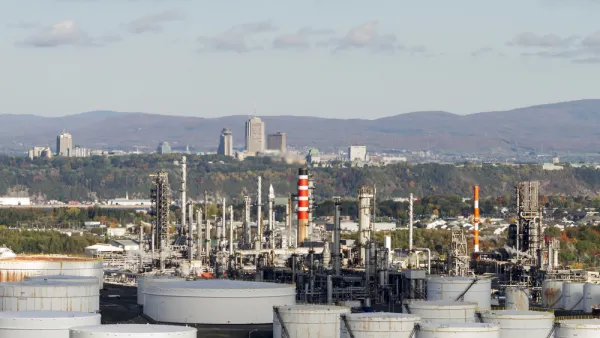
Canadian Supreme Court Upholds Carbon Tax
A historic ruling in Canada allows the federal government to supersede the efforts of provinces in fighting the causes of climate change.

Major Changes Coming to British Columbia's Carbon Tax
The government of British Columbia, put in power this year with the help of the BC Green Party, is shoring up its climate change action resume.

Planetizen Federal Action Tracker
A weekly monitor of how Trump’s orders and actions are impacting planners and planning in America.

Amtrak, CN end decades-long dispute with eight-year agreement
The new operating agreement establishes an updated framework for the companies to work together, including processes to resolve disputes.

Northwest rail fans eager for Sept. 30 debut of Amtrak’s Airo fleet
Get ready for that new train smell and more seats. But they won’t go faster or run more frequently on the Cascades route in Washington and Oregon.

St. Louis Metro to test if single-car trains can reduce operating costs, maintain rider satisfaction
The pilot program will run from October to spring 2027, and begin with one single-car train operating on Metrolink’s Red and Blue lines.

Pennsylvania is building data centers in abandoned mines
Housing data centers in mines provides an alternative to destroying local forests and may spare residents from data centers’ noise and air pollution.

If Corpus Christi can’t revive desalination plant project, it may owe Texas $235 million
Earlier this month, city officials declined to pursue developing the plant for the second time in a year.

FREE Course: Walkable City 1: Why Walkability?
After describing his path towards focusing on walkability as the essence of good planning, Jeff Speck marches through his five principal reasons for making more walkable places.
Reinventing Malls: Planning Alchemy—Turning Gray Fields Into Gold
The course focuses on the opportunities and imperatives that shape reinvention of mall sites.

City of Thousand Oaks
City of Wisconsin Rapids
Harvard University Graduate School of Design
The Architects Foundation
University of Cincinnati Online
The Pocatello Development Authority
The Urban Renewal Agency of the City of Pocatello