The House Appropriations Subcommittee on Transportation and HUD has proposed drastic cuts to Community Development Block Grants and eliminating funding for the Partnership for Sustainable Communities and TIGER. The cuts presage coming budget battles.


"Constrained by Paul Ryan’s budget and the sequester, the House Appropriations Subcommittee on Transportation and HUD passed a $44 billion spending bill for 2014 – 15 percent lower than 2013 enacted levels," reports Tanya Snyder. "The bill contains $15.3 billion in discretionary appropriations for the Department of Transportation, also 15 percent below enacted 2013 levels and amounting to about two-thirds of the president’s request."
"The budget would eliminate both TIGER and high-speed rail funding (as have all House-passed budgets in recent memory), cut Amtrak’s subsidy by a third, and bring HUD’s Community Development Block Grants back to Ford administration levels," she notes. "While the cuts are steep, as in past years they are unlikely to be enacted, given Democratic control of the Senate."
"The House’s austerity package will meet with firm opposition in the Democratic-controlled Senate, which will likely pass something along the lines of President Obama’s budget proposal — more than twice what the House is willing to spend — leading to another budget stalemate and, likely, yet another continuing resolution that just maintains current spending levels for next year."
Read the full story: “The Twilight of the Appropriations Process”: House GOP Gets Its Knives Out

$100 Million for HUD Sustainability Program Survives Budget Cuts
Congressional budget cuts spare some favorite programs of transportation reformers and smart growth advocates.
Planning Programs to Watch in the Federal Omnibus Spending Bill
Congress is on pace to wrap up a major piece of federal legislation before leaving for recess.
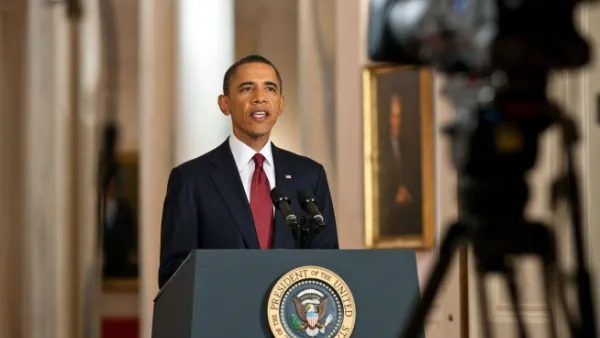
Grading Obama's Approach to Transportation
Was Obama's top transportation achievement his decision to name Ray LaHood as U.S. DOT secretary? That's the argument Tanya Snyder makes in evaluating the President's hits and misses regarding transportation policy.

Planetizen Federal Action Tracker
A weekly monitor of how Trump’s orders and actions are impacting planners and planning in America.

California plans to bury El Niño’s downpour
If the state plays its cards right, it may be able to store a billion acre-feet of El Niño’s water in aquifers.

Desperate measures: Advocates weigh draining Lake Powell to fill Colorado River
Draining the reservoir could reduce evaporation losses by a couple hundred thousand acre-feet.

In Texas, data centers are swallowing promised parkland
Residents who moved to Taylor, Texas for a rural community now have to contend with three data centers in their backyard.

How a Chicago-sized wind farm beat the odds and powered on
The project spanned five presidential administrations and a standoff with a U.S. military base.

MTA gives itself 30 days to transform pit into basketball court
The site has been under construction since 2022; the city originally estimated it would finish the court in 2024.

FREE Course: Walkable City 1: Why Walkability?
After describing his path towards focusing on walkability as the essence of good planning, Jeff Speck marches through his five principal reasons for making more walkable places.
Reinventing Malls: Planning Alchemy—Turning Gray Fields Into Gold
The course focuses on the opportunities and imperatives that shape reinvention of mall sites.

City of Rosemead
Rutgers University, Edward J. Bloustein School of Planning and Public Policy
One Hundred Miles
Hunter College, City University of New York (CUNY)
The Architects Foundation
University of Cincinnati Online
City of Cambridge
Montrose County
The Pocatello Development Authority