As suburban office parks struggle to lure tenants not decamping for more urban environments, some are investing princely sums to renovate their buildings in the hope of capturing a slice of the shrinking pie.


"Owners of suburban office space in [New Jersey] face a difficult environment," writes Ronda Kaysen. "Eighty percent of the office buildings were built in the 1980s and 1990s during the reign of the suburban, self-contained corporate campus, according to a report by Rutgers University [PDF]. But over the last decade, businesses and workers fled the isolation of the suburbs in favor of accessible city centers. Added to that, businesses have been reluctant to sign leases or expand operations in a lackluster economy."
While some office parks are embarking on mixed-use redevelopment in the face of high vacancy rates and low rents, others are taking a different tack and investing in costly renovations to create corporate campuses "updated for a modern work force." One example is Novo Nordisk's new North American headquarters in Plainsboro, where a $225 million gut renovation "took a drab, bunkerlike edifice and made it a shiny example of how New Jersey’s aging suburban office stock could be reimagined for a new era."
Read the full story: Drab Office in New Jersey Gets the Cinderella Treatment
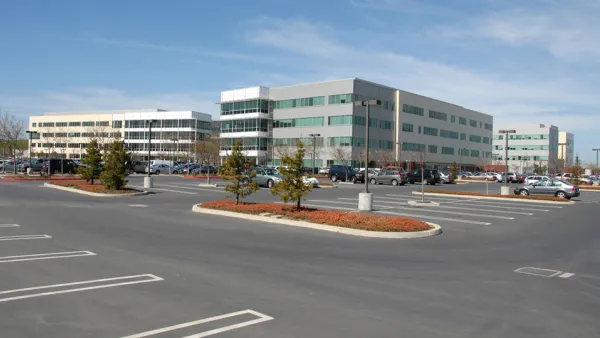
Report: Office Parks Increasingly Obsolete
According to a report prepared by commercial real estate firm Newmark, Grubb, Knight and Frank (NGKF), the office park model has lost the competitive edge. That is, unless it provides access to transit and urban amenities as well as parking.
Google's Loss is LinkedIn's Gain in Silicon Valley
The city of Mountain View chose to allot most of the redevelopment rights in its much sought-after North Bayshore area not to the city's largest employer and taxpayer but to LinkedIn's more conventional proposal.
Developing a Second Life for the Suburban Office Park
Across America, developers and municipalities are trying to adapt a relic of the sprawling post-war suburbs for a more urbane 21st century. Can office park makeovers revive these increasingly barren landscapes?

Planetizen Federal Action Tracker
A weekly monitor of how Trump’s orders and actions are impacting planners and planning in America.

California plans to bury El Niño’s downpour
If the state plays its cards right, it may be able to store a billion acre-feet of El Niño’s water in aquifers.

Desperate measures: Advocates weigh draining Lake Powell to fill Colorado River
Draining the reservoir could reduce evaporation losses by a couple hundred thousand acre-feet.

Los Angeles just elected an urban planner as its mayor
Transportation analysts are optimistic that Raman will be more aggressive in addressing transit issues than Bass.

Mamdani’s pied-à-terre tax survives legal challenge
A panel of judges found that the plaintiffs failed to demonstrate injury as a result of New York City's implementation of the tax.

Eastern Nebraska is running out of electricity
Data centers and electrification are straining eastern Nebraska’s grid, throttling economic development.

FREE Course: Walkable City 1: Why Walkability?
After describing his path towards focusing on walkability as the essence of good planning, Jeff Speck marches through his five principal reasons for making more walkable places.
Reinventing Malls: Planning Alchemy—Turning Gray Fields Into Gold
The course focuses on the opportunities and imperatives that shape reinvention of mall sites.

City of Rosemead
Rutgers University, Edward J. Bloustein School of Planning and Public Policy
One Hundred Miles
University of Michigan School for Environment and Sustainability (SEAS)
Hunter College, City University of New York (CUNY)
The Architects Foundation
City of Cambridge
Montrose County
The Pocatello Development Authority