A new report paints a grim picture of San Francisco’s traffic future. Without radical reductions in auto usage, the city’s downtown will be ‘mired in gridlock.’ Is a controversial congestion pricing scheme the solution?


A new report by the San Francisco County Transportation Authority reveals that “[u]nless private automobile traffic is reduced by 27 percent over the next three decades, congestion levels in [downtown San Francisco] will be unmanageable, with vehicles stuck at a standstill and pedestrians and cyclists prone to increasingly dangerous conditions,” says Will Reisman.
Could “a long-discussed and controversial congestion-pricing scheme” be the solution?
Although “[i]nstalling bike paths, widening sidewalks and adding high-occupancy vehicle lanes to freeway on-ramps,” could potentially reduce gridlock, a congestion pricing scheme previously studied by the Transportation Authority could cut traffic by 10 to 15 percent, says the new report. “It also would generate tens of millions of dollars for other transit needs.”
Read the full story: Driver fees could help combat gridlock
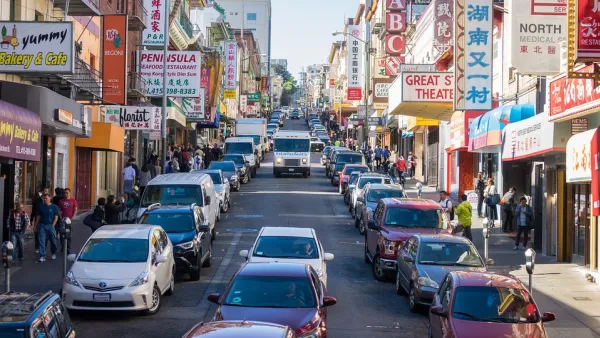
Congestion Pricing Scheme Up for Discussion in San Francisco
The public is providing feedback for the idea of a congestion pricing scheme that could charge as much as $12 to drive into Downtown San Francisco.
Congestion Pricing Has Mayoral Support in San Francisco
Additional disincentives for driving (i.e., congestion pricing and new parking fees) are on the mayor's agenda in San Francisco.
Congestion Pricing Under Discussion in San Francisco
An expanding number of major U.S. cities are exploring the idea of charging drivers to drive into certain heavily trafficked parts of town. San Francisco is the most recent to explore the idea of congestion pricing (also known as cordon pricing).

Planetizen Federal Action Tracker
A weekly monitor of how Trump’s orders and actions are impacting planners and planning in America.

California plans to bury El Niño’s downpour
If the state plays its cards right, it may be able to store a billion acre-feet of El Niño’s water in aquifers.

Desperate measures: Advocates weigh draining Lake Powell to fill Colorado River
Draining the reservoir could reduce evaporation losses by a couple hundred thousand acre-feet.

In Texas, data centers are swallowing promised parkland
Residents who moved to Taylor, Texas for a rural community now have to contend with three data centers in their backyard.

How a Chicago-sized wind farm beat the odds and powered on
The project spanned five presidential administrations and a standoff with a U.S. military base.

MTA gives itself 30 days to transform pit into basketball court
The site has been under construction since 2022; the city originally estimated it would finish the court in 2024.

FREE Course: Walkable City 1: Why Walkability?
After describing his path towards focusing on walkability as the essence of good planning, Jeff Speck marches through his five principal reasons for making more walkable places.
Reinventing Malls: Planning Alchemy—Turning Gray Fields Into Gold
The course focuses on the opportunities and imperatives that shape reinvention of mall sites.

City of Rosemead
Rutgers University, Edward J. Bloustein School of Planning and Public Policy
One Hundred Miles
Hunter College, City University of New York (CUNY)
The Architects Foundation
University of Cincinnati Online
City of Cambridge
Montrose County
The Pocatello Development Authority