With Earth Engine, Google has compiled decades of images taken by Earth-observing satellites. The tool is meant for "scientists, independent researchers, and nations...to detect changes, map trends and quantify differences on the Earth's surface."


"Today, Google put out the Earth Engine, a fascinating tool that showcases a scrollable, zoomable time-lapse of the entire planet as seen by Landsat over the decades," writes Colin Schultz. According to Rebecca Moore, Engineering Manager with Google Earth Engine & Earth Outreach, the images paint "the most comprehensive picture of our changing planet ever made available to the public."
"The Landsat photos only go back to 1984," says Schultz, "but they show the dramatic ways in which the planet has changed in such a brief period of time. To help you get started, Google pulled out some highlights to look at, such as the drying of the Aral Sea or the deforestation of the Amazon. But the tool does show the whole planet (just the land, not the oceans), and there are many more cool things to be seen."
Read the full story: 28-Year Satellite Time-Lapse Shows Exactly What We’re Doing to Our Planet

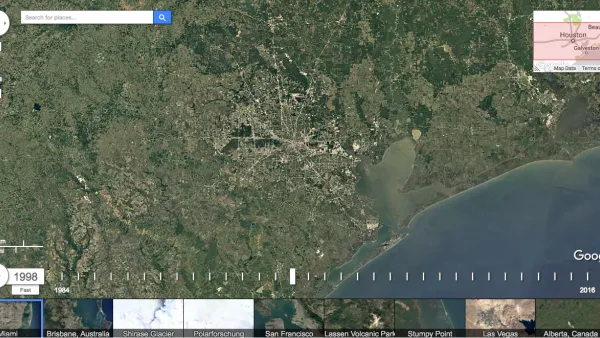
Friday Eye Candy: A 30-Year Timelapse Reveals Humanity's Expanding Footprint
The Google Timelapse feature has been updated. The only thing that stays the same is that everything changes.
Google will fund removal of 2000 acres of trees in Oklahoma to save water while building new data center
The company has invested $30 million into projects intended to address Oklahoma’s water shortage.

Google Razed 80 Acres in Downtown San Jose. Then… Nothing Happened.
The project was expected to generate about $79 million annually in property taxes.

Planetizen Federal Action Tracker
A weekly monitor of how Trump’s orders and actions are impacting planners and planning in America.

Amtrak, CN end decades-long dispute with eight-year agreement
The new operating agreement establishes an updated framework for the companies to work together, including processes to resolve disputes.

Northwest rail fans eager for Sept. 30 debut of Amtrak’s Airo fleet
Get ready for that new train smell and more seats. But they won’t go faster or run more frequently on the Cascades route in Washington and Oregon.

Brightline Florida files for bankruptcy
The transit company is over $5 billion in debt.

St. Louis Metro to test if single-car trains can reduce operating costs, maintain rider satisfaction
The pilot program will run from October to spring 2027, and begin with one single-car train operating on Metrolink’s Red and Blue lines.

Pennsylvania is building data centers in abandoned mines
Housing data centers in mines provides an alternative to destroying local forests and may spare residents from data centers’ noise and air pollution.

FREE Course: Walkable City 1: Why Walkability?
After describing his path towards focusing on walkability as the essence of good planning, Jeff Speck marches through his five principal reasons for making more walkable places.
Reinventing Malls: Planning Alchemy—Turning Gray Fields Into Gold
The course focuses on the opportunities and imperatives that shape reinvention of mall sites.

City of Thousand Oaks
City of Wisconsin Rapids
Harvard University Graduate School of Design
The Architects Foundation
University of Cincinnati Online
The Pocatello Development Authority
The Urban Renewal Agency of the City of Pocatello