The Google Timelapse feature has been updated. The only thing that stays the same is that everything changes.


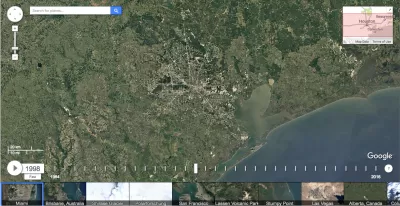
"The team behind Google Earth released an update [in November] to the Timelapse feature of its satellite imagery app, and it’s a great way to see the rapid pace of urban development and public infrastructure projects," writes Nick Statt.
As described by the Google Earth Engine website, the Timelapse feature "is a global, zoomable video that lets you see how the Earth has changed over the past 32 years. It is made from 33 cloud-free annual mosaics, one for each year from 1984 to 2016, which are made interactively explorable by Carnegie Mellon University CREATE Lab's Time Machine library…."
The Timelapse feature launched in 2013, but the recent data brings the feature into contemporary times. A separate article by Peter Hess in Popular Science points out the obvious effects of climate change, as made visible by the Timelapse tool. Local media outlets from all over the country, like St. Louis, Los Angeles, and San Francisco, picked up news of the update as well.
Timelapse is available, in all its glory, below.
Read the full story: Google Earth’s Timelapse update illustrates 30 years of climate change

Friday Eye Candy: 'Time-Lapse Mining' Reveals a Changing Planet
Someone's done the hard work of finding, sorting, and stitching together millions of photos from the Internet to create animated portraits of the evolution of places.
Earth Engine: Google's Global Time-Lapse
With Earth Engine, Google has compiled decades of images taken by Earth-observing satellites. The tool is meant for "scientists, independent researchers, and nations...to detect changes, map trends and quantify differences on the Earth's surface."
Google will fund removal of 2000 acres of trees in Oklahoma to save water while building new data center
The company has invested $30 million into projects intended to address Oklahoma’s water shortage.

Planetizen Federal Action Tracker
A weekly monitor of how Trump’s orders and actions are impacting planners and planning in America.

The state-sanctioned urbicide of Austin
People don’t kill cities. Freeways do.

US to reduce Colorado River water deliveries to Mexico
A new Colorado Treaty amendment reduces Mexico’s Colorado River water allocation by 250,000 acre feet.

Brightline West’s future may rely on $6 billion federal loan
The company has until Nov. 2 to make a $400 million equity investment into its proposed high-speed rail line.

LA Metro’s ultimatum: no extra buses for LA28 if federal funding isn’t imminently secured
If Metro does not provide additional buses, LA28 organizers will have to find a new way to manage Olympic traffic. LA28’s budget does not include a line item for transit.

Colorado’s Largest Data Center Could Rise Next to Homes — Without a Public Hearing
The proposed campus would consume 11 times the power of Denver International Airport; as it has across the country, opposition mounts.

FREE Course: Walkable City 1: Why Walkability?
After describing his path towards focusing on walkability as the essence of good planning, Jeff Speck marches through his five principal reasons for making more walkable places.
Reinventing Malls: Planning Alchemy—Turning Gray Fields Into Gold
The course focuses on the opportunities and imperatives that shape reinvention of mall sites.

Eagle County Government
Harvard University Graduate School of Design
Nashville Planning Department
The Architects Foundation
University of Cincinnati Online
The Pocatello Development Authority
The Urban Renewal Agency of the City of Pocatello
Journal of the American Planning Association