The UK's supreme court ruled this week that the government has failed to live up to its legal obligation to curb air pollution, in breach of an EU air quality directive.


Following recent reports of Britain's growing pollution-caused public health crisis, the UK's supreme court has ruled that it's time the government did something about it. "The ruling by five judges [PDF] – the first time a UK court has recognised that the government has failed in efforts to meet European air pollution limits – delighted air pollution campaigners," reports John Vidal.
"The ruling marks a turning point in the fight for clean air and will pile the pressure on the environment secretary, Owen Paterson. He must now come up with an ambitious plan to protect people from carcinogenic diesel fumes. Until now, his only policy has been lobbying in Europe to try and weaken air pollution laws," said James Thornton, chief executive of ClientEarth, the group that brought the case.
"With the possibility of heavy fines and European commission action closer, Britain may now have little option but to come forward with ambitious new plans to reduce NO2 pollution in cities," notes Vidal. "Because most of the pollution is from cars, these could include ultra low-emission zones, bans on certain vehicles and the use of technological 'solutions' such as dust suppressants."
Read the full story: UK government failing legal duty on air pollution, supreme court rules
Decisive Supreme Court Win for Clean Air and Public Health
In a huge and perhaps unexpected win for the EPA, the Supreme Court on April 29 reversed an appellate court panel ruling that had rejected their attempt to regulate interstate air pollution caused by about 1,000 coal-fired power plants in 28 states.

Trump asks Supreme Court to allow border wall through Texas national park
Judge Kathleen Cardone previously blocked the Big Bend border wall project, and Texas’ Land Commissioner has spoken out against it as well.
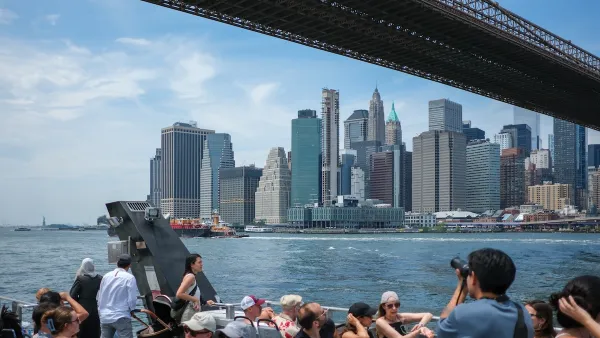
This 55-year-old boat is NYC’s first step towards moving freight deliveries from land to sea
New York City hopes to reduce emissions by creating a 'blue highways' program that embraces boats as a means of transporting freight.

Planetizen Federal Action Tracker
A weekly monitor of how Trump’s orders and actions are impacting planners and planning in America.

Eastern Nebraska is running out of electricity
Data centers and electrification are straining eastern Nebraska’s grid, throttling economic development.

Study reveals best places in the U.S. for cycling, walking
New research from Streetlight Data examines bicycle and pedestrian miles per capita in the 100 largest U.S. cities by population.

All sides of BRT debate unhappy with CDOT’s most recent move
The Colorado Department of Transportation is no longer considering center-running bus lanes for Colorado Boulevard.

Massachusetts bogs generate both power, and cranberries
Putting solar panels above farmland is one way Massachusetts is advancing toward its goal of net-zero carbon emissions by 2050.

What could the future of LA transit look like under Raman?
The mayor-elect views broken sidewalks and potholes as crises that can be fixed with better governance.

FREE Course: Walkable City 1: Why Walkability?
After describing his path towards focusing on walkability as the essence of good planning, Jeff Speck marches through his five principal reasons for making more walkable places.
Reinventing Malls: Planning Alchemy—Turning Gray Fields Into Gold
The course focuses on the opportunities and imperatives that shape reinvention of mall sites.

City of Rosemead
Rutgers University, Edward J. Bloustein School of Planning and Public Policy
One Hundred Miles
University of Michigan School for Environment and Sustainability (SEAS)
Hunter College, City University of New York (CUNY)
The Architects Foundation
City of Cambridge
The Pocatello Development Authority
The Urban Renewal Agency of the City of Pocatello