According to Arianna McBride, the recipe for good community design must effectively balance community wisdom with expert knowledge. She shares three ways that planners can facilitate the type of participation that leads to great places.


Balancing community input with the expert knowledge of designers and planners is the key challenge in developing effective outreach strategies and creating projects of lasting value.
"Too often community projects favor one of these approaches over the other; the design team who drops in for a week with the solution to a town’s traffic woes (i.e. roundabout) or the community workshop that recycles the same, old idea for its downtown’s redevelopment (i.e. more parking)," says McBride. "So, how do we move off of this dynamic towards a more effective model? By recognizing the best of what both sides bring to the equation and designing a process that leverages both strengths."
"At the Orton Family Foundation we use an approach called Heart & Soul Community Planning, which strives to put community wisdom first in projects and uses design and planning professionals to help make the most of this valuable asset." McBride discusses three key tactics that help facilitate this process:
- Listen First.
- Ask powerful questions.
- Create feedback loops.
Read the full story: Community Wisdom + Expert Knowledge = Good Community Design

A Better Way to Plan School Facilities
Taking a wider view of communities could help keep schools open despite falling enrollment.

Rebuilding Together: How One Baltimore Program Advanced Education and Community Development
When Baltimore got funding for a round of school renovations, the state directed it to design schools that would also advance neighborhood revitalization — and it learned some lessons about why that's not always so simple.
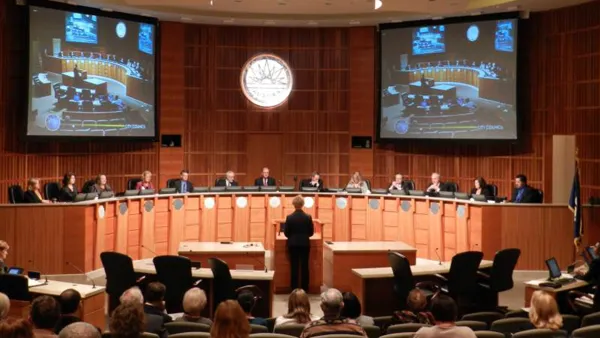
Is 'Hacking' a Planning Commission a Good Idea?
Does giving short shrift to grassroots tradition cut against the dynamics of community-based decision-making?

Planetizen Federal Action Tracker
A weekly monitor of how Trump’s orders and actions are impacting planners and planning in America.

California plans to bury El Niño’s downpour
If the state plays its cards right, it may be able to store a billion acre-feet of El Niño’s water in aquifers.

Desperate measures: Advocates weigh draining Lake Powell to fill Colorado River
Draining the reservoir could reduce evaporation losses by a couple hundred thousand acre-feet.

Los Angeles just elected an urban planner as its mayor
Transportation analysts are optimistic that Raman will be more aggressive in addressing transit issues than Bass.

Mamdani’s pied-à-terre tax survives legal challenge
A panel of judges found that the plaintiffs failed to demonstrate injury as a result of New York City's implementation of the tax.

Eastern Nebraska is running out of electricity
Data centers and electrification are straining eastern Nebraska’s grid, throttling economic development.

FREE Course: Walkable City 1: Why Walkability?
After describing his path towards focusing on walkability as the essence of good planning, Jeff Speck marches through his five principal reasons for making more walkable places.
Reinventing Malls: Planning Alchemy—Turning Gray Fields Into Gold
The course focuses on the opportunities and imperatives that shape reinvention of mall sites.

City of Rosemead
Rutgers University, Edward J. Bloustein School of Planning and Public Policy
One Hundred Miles
University of Michigan School for Environment and Sustainability (SEAS)
Hunter College, City University of New York (CUNY)
The Architects Foundation
City of Cambridge
Montrose County
The Pocatello Development Authority