Soleri, the founder of the experiential community of Arcosanti, who in many ways presaged the modern sustainability movement, passed away on Tuesday at Cosanti, his home in Paradise Valley, Arizona.


"Dr. Soleri, who apprenticed with Frank Lloyd Wright in the 1940s, developed a philosophy he called arcology — architecture coupled with ecology — that some saw as an answer to suburban sprawl," writes Fred A. Bernstein in an obituary for The New York Times. "It involved building densely packed, bee-hive-like buildings that 'held out a promise of not just an alternative architecture but alternative culture,' the architecture critic Paul Goldberger wrote in The New York Times in 1989."
"Dr. Soleri’s basic idea was that architecture and ecology are inseparable in their effect on people," explains Bernstein. "In his view, technology always moves toward miniaturization, just as nature tends toward complexity and compactness. Human habitation, he believed, must also move toward more compact, multilayered and multidimensional spaces instead of scattering or spreading across the landscape."
Read the full story: Paolo Soleri, Architect of Counterculture, Dies at 93


Planetizen Federal Action Tracker
A weekly monitor of how Trump’s orders and actions are impacting planners and planning in America.

Data reveals that NYC’s bet on congestion pricing has paid off
After almost two years of the program, reports show positive impacts on traffic and air quality and no disruptions to parking.
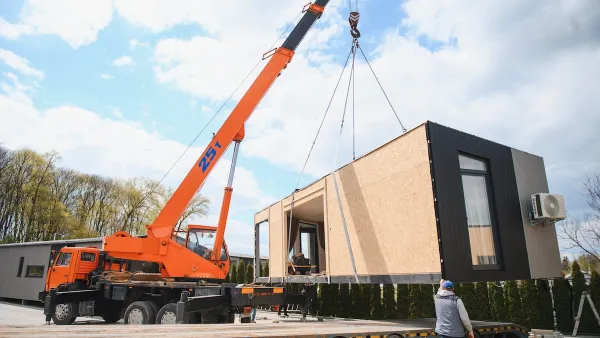
HUD modernizes 50-year-old manufactured housing framework
The Next Generation Manufactured Housing Action Plan establishes new energy-efficiency standards for manufactured homes, and new guidelines for anchoring them.

Florida could lose billions in funding for infrastructure, parks
If Amendment 3 passes, Miami-Dade would lose about $445 million annually by fiscal year 2028-29.

New Mexico spent millions drafting climate goals. Data centers are unraveling them
Three data centers in New Mexico and El Paso will release more emissions yearly than 2 million cars in the same timeframe.

This Ohio town is using AI to speed up transit analysis
The Greater Dayton Regional Transit Authority’s new AI tool correctly determined riders’ preferred ways to reach key commuter routes.

FREE Course: Walkable City 1: Why Walkability?
After describing his path towards focusing on walkability as the essence of good planning, Jeff Speck marches through his five principal reasons for making more walkable places.
Reinventing Malls: Planning Alchemy—Turning Gray Fields Into Gold
The course focuses on the opportunities and imperatives that shape reinvention of mall sites.

Rutgers University, Edward J. Bloustein School of Planning and Public Policy
One Hundred Miles
County of Mendocino
The Architects Foundation
University of Cincinnati Online
Montrose County
Northern Illinois Transit Authority (NITA)
The Pocatello Development Authority