If the U.S. Air Force has its wish, America's next subway system won't be built in a city and won't carry passengers (not human ones anyway). Robert Beckhusen reports on plans for a "mobile doomsday train."


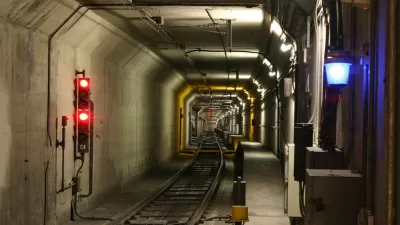
"The Air Force wants to upgrade its aging nuclear missiles and the hundreds of underground silos that hold them," says Beckhusen. "One idea it’s exploring: the construction of a sprawling network of underground subway tunnels to shuttle the missiles around like a mobile doomsday train. As one does."
"As first reported by Inside Defense, the Air Force Nuclear Weapons Center will award several study contracts next month worth up to $3 million each to research the idea. A broad agency announcement from the Air Force describes the hair-raising concept, intended to keep the weapons secure through 2075, as a system of tunnels where nuclear missiles are shuttled around on rails or some undefined 'trackless' system."
"The project would likely be gigantic, expensive and take decades to build — all things that cut against cut against these relatively lean times at the Pentagon," cautions Beckhusen. But other options for replacing the U.S.’ silo-launched nuclear arsenal of 420 Minuteman III ballistic missiles seem equally costly and complex.
Read the full story: That’s No Train! Air Force Eyes Subway for Nuclear Missiles
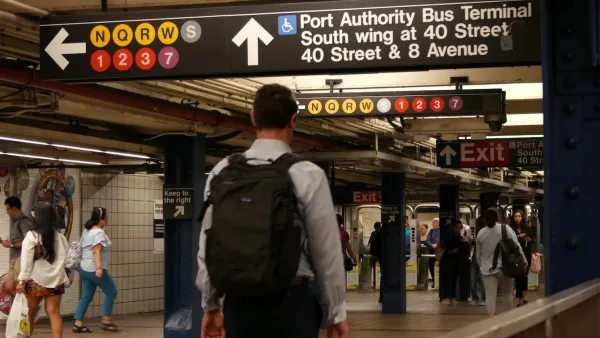
MTA looks to bring AI-assisted, multilingual announcement system to subways
Some of the transit agency’s audio systems haven’t been upgraded in 40 years.
NYC's sweltering subway tunnels might soon provide heat to nearby buildings
The MTA is studying how a Thermal Energy Network could capture extreme excess heat from subway platforms to warm nearby municipal buildings.
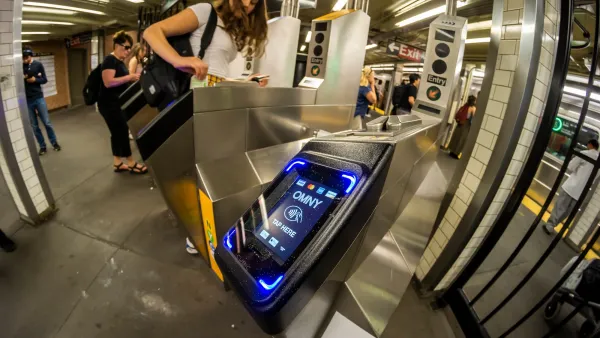
Popular transit payment system linked to Palantir could give ICE access to rider data
The tap-to-pay system is being used widely in transit systems including New York City, Boston and Chicago.

Planetizen Federal Action Tracker
A weekly monitor of how Trump’s orders and actions are impacting planners and planning in America.

Eastern Nebraska is running out of electricity
Data centers and electrification are straining eastern Nebraska’s grid, throttling economic development.

Move over, LA: St. Louis gears up for Olympics, invests millions in downtown redevelopment
The Missouri city will host the 2028 Olympic soccer group stage and knockout matches.

Dallas releases zoning code overhaul to officials
The drafted overhaul is over 400 pages long.

NYC renovations for dangerous, ‘mercilessly crammed’ street delayed until 2027
Construction was supposed to begin this fall.

San Diego’s Midway Rising project gets greenlight from city council
The project looks to become the largest affordable housing development in California's history.

FREE Course: Walkable City 1: Why Walkability?
After describing his path towards focusing on walkability as the essence of good planning, Jeff Speck marches through his five principal reasons for making more walkable places.
Reinventing Malls: Planning Alchemy—Turning Gray Fields Into Gold
The course focuses on the opportunities and imperatives that shape reinvention of mall sites.

City of Rosemead
Rutgers University, Edward J. Bloustein School of Planning and Public Policy
One Hundred Miles
University of Michigan School for Environment and Sustainability (SEAS)
Hunter College, City University of New York (CUNY)
The Architects Foundation
City of Cambridge
The Pocatello Development Authority
The Urban Renewal Agency of the City of Pocatello