For the first time in 15 years, the American Society of Civil Engineers' report on the state of America's infrastructure sees improvement. But the group has identified the need for $3.6 trillion in investment by 2020 to fix enduring problems.


Released every four years, "[t]he latest Report Card for America’s Infrastructure, released Tuesday, has an unexpected bit of qualified good news: the grade has inched up to a D+," reports John Schwartz. "It is the first time in the 15 years that the engineering organization has conducted its study that the grade has improved."
"Some connected trends have led to the shift, according to the engineering organization. It cited a rise in the private financing of public projects and renewed attention from state and local government to kick-start their own projects, rather than wait for Washington to send money. The jump in private investment was instrumental, for example, in the improved outlook for the nation’s rails, according to the report. That evaluation jumped to a C+ from a C-. The group also cited short-term increases in financing — a reference to President Obama’s economic stimulus package, which focused in part on 'shovel-ready' projects like road and bridge repair."
“When investments are made and projects move forward, the grades rise,” the report stated.
"Gregory E. DiLoreto, the group’s president, said, 'A D+ is simply unacceptable for anyone serious about strengthening our nation’s economy,' but he added that the improvement 'shows that this problem can be solved.'”
Read the full story: Small Infrastructure Gains Are Observed in Engineering Report

Civil Engineers Release U.S. Infrastructure Scorecard: D+
Every four years the American Society of Civil Engineers issues a report on the state of America's infrastructure, extensively cited by the media. This year's report, released March 9, shows no improvement over 2013's, but do check the subcategories
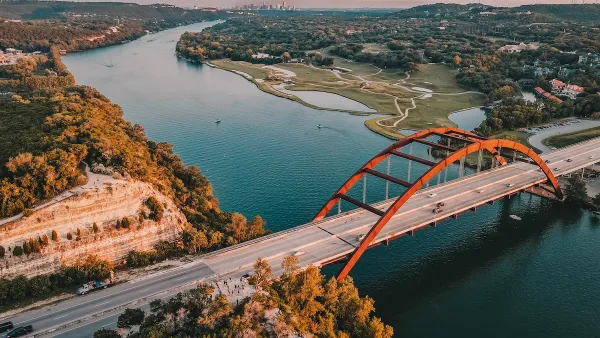
Texas Infrastructure Gets a ‘C’
The American Society of Civil Engineers rates states in 16 categories related to transportation, water, waste management, parks, and more.
Rebuilding America's Backbone: A Call for Resilient Infrastructure
How sustainable investments in infrastructure made today can secure the future.

Planetizen Federal Action Tracker
A weekly monitor of how Trump’s orders and actions are impacting planners and planning in America.

Amtrak, CN end decades-long dispute with eight-year agreement
The new operating agreement establishes an updated framework for the companies to work together, including processes to resolve disputes.

Judges permit Denver to divert 77,000 acre feet from the Colorado River for reservoir expansion
Overuse and climate change have caused the Colorado River’s water levels to plummet.

NYC DOT wants faster, more permanent street upgrades
The city is examining ways to build more concrete infrastructure without getting entangled in 'decades-long' projects.

'Something we’ve never seen before:' rising utility rates could strain city finances nationwide
Data centers, climate change and other factors have caused utility rates in the United States to increase by 38% since 2020.

Trump to overrule local leaders, lease millions of acres of America’s Pacific Island territories’ seafloors to mining companies
International law says that the Indigenous people of America’s territories have a right to prior and informed consent regarding projects that impact their countries.

FREE Course: Walkable City 1: Why Walkability?
After describing his path towards focusing on walkability as the essence of good planning, Jeff Speck marches through his five principal reasons for making more walkable places.
Reinventing Malls: Planning Alchemy—Turning Gray Fields Into Gold
The course focuses on the opportunities and imperatives that shape reinvention of mall sites.

Harvard University Graduate School of Design
KFH Group Inc.
Greater Baltimore Committee
The Architects Foundation
University of Cincinnati Online
The Pocatello Development Authority
The Urban Renewal Agency of the City of Pocatello