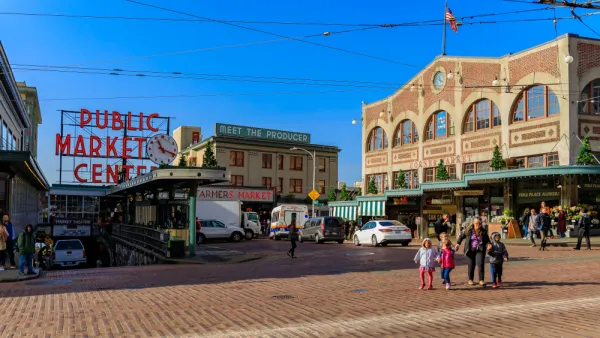
Pike Place Market, one of Seattle's most visited tourist sites, and one of the prime models for the rediscovered allure of America's public markets, is primed for a significant expansion thanks to a recently approved agreement.


With the Seattle City Council’s Central Waterfront Committee's approval of Council Bill 117699, an agreement to develop its last under-developed historic site (known as PC-1 North), Pike Place Market is poised for a new milestone, writes Seattle City Council member Jean Godden.
Architects Miller Hull have developed a design for the .75 acre site that "will provide additional market parking, added retail space and several stories of low-income and artist housing."
"The structure at PC1-North, designed to fit into its site with a low profile and preserve views toward the West, will create more room at the Market for booths and sellers, more room for the market’s fresh produce and organic specialties, all supplemented by increased parking and access," says Godden.
"But, more than that, the infill site will anchor a spectacular sloping walkway that will link the Market to the Waterfront, providing easy access for pedestrians between the two. The walkway will serve up matchless views of Elliott Bay all along the way. There will be ample room on the promenade for public art and green outlooks."
"The change will present the Market with a fantastic opportunity," she adds. "But the opportunity is just as great or greater for Seattle’s emerging waterfront which will benefit from easy access to Seattle’s prime tourist attraction."
Read the full story: Pike Place Market: Oh, what you are about to see
The 5 Worst Streets in Seattle
Want to know which streets are most likely to produce a negative emotional response among Seattle transportation safety advocates? Read on.
$73 Million Expansion Underway for Seattle's Pike Place Market
One of Seattle's most recognizable locations began work on sweeping changes on June 24, 2015.

Housing is the top priority of Seattle’s sole new councilmember
Jenks campaigned on building 1,000 new units of affordable housing.

Planetizen Federal Action Tracker
A weekly monitor of how Trump’s orders and actions are impacting planners and planning in America.

California plans to bury El Niño’s downpour
If the state plays its cards right, it may be able to store a billion acre-feet of El Niño’s water in aquifers.

Desperate measures: Advocates weigh draining Lake Powell to fill Colorado River
Draining the reservoir could reduce evaporation losses by a couple hundred thousand acre-feet.

Housing is the top priority of Seattle’s sole new councilmember
Jenks campaigned on building 1,000 new units of affordable housing.

New tax cuts may slash $1.5 billion in funding for Miami transit, public parks
Amendment 3 will save Miami-Dade homeowners $2,700 in 2028.

Arizona, Wisconsin, Pennsylvania hope to finally advance climate goals post-midterms
The three states have spent years under Republican or divided control.

FREE Course: Walkable City 1: Why Walkability?
After describing his path towards focusing on walkability as the essence of good planning, Jeff Speck marches through his five principal reasons for making more walkable places.
Reinventing Malls: Planning Alchemy—Turning Gray Fields Into Gold
The course focuses on the opportunities and imperatives that shape reinvention of mall sites.

City of Rosemead
Rutgers University, Edward J. Bloustein School of Planning and Public Policy
One Hundred Miles
University of Michigan School for Environment and Sustainability (SEAS)
Hunter College, City University of New York (CUNY)
The Architects Foundation
City of Cambridge
Montrose County
The Pocatello Development Authority