The Providence Arcade, thought to be America's oldest enclosed shopping mall, suffered the same fate as many of its 20th century brethren when it was shuttered in 2008. A developer seeks to revive the building as a mixed-use "micro-loft" complex.


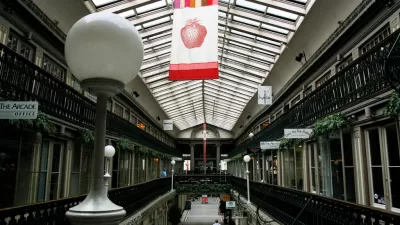
"Built in 1828 and declared a National Historical Landmark in 1976, the Providence Arcade — otherwise known as the Westminster Arcade or simply 'the Arcade' if you're a local— is known for its 'distinguished Greek Revival columns, granite walls, and classic facades,'” writes Matt Hickman. Despite its fine design and distinguished history, the arcade was not immune from the effects of the recession, and it shuttered in 2008.
A trendsetter from its birth, the vision for the arcade's renaissance is based on an emerging trend in urban living - micro-housing. "Developer Evan Granoff of 130 Westminster Street Associates believes that the salvation of the stately building with the big columns and huge history lies within tiny living ... and retailing." Retail space will average 400 square feet, while the 48 "micro-lofts" in the buildings upper floors will measure between 225 and 450 square feet.
"With a move-in date slated for later this spring, you can preview the Providence Arcade's micro-makeover at a museum exhibition that I'm finding myself writing about a lot these days: "Making Room: New Models for Housing New Yorkers” at the Museum of the City of New York," writes Hickman. "Floor plans, additional renderings, and a bit of the building's history can also be found at the development's website."
Read the full story: America's oldest indoor shopping mall to be reborn as mixed-use micro-loft complex

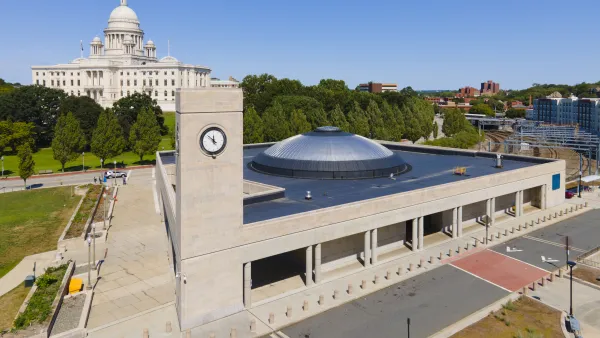
Providence train station to gain new bus hub
The new hub will replace the one currently located at Kennedy Plaza.
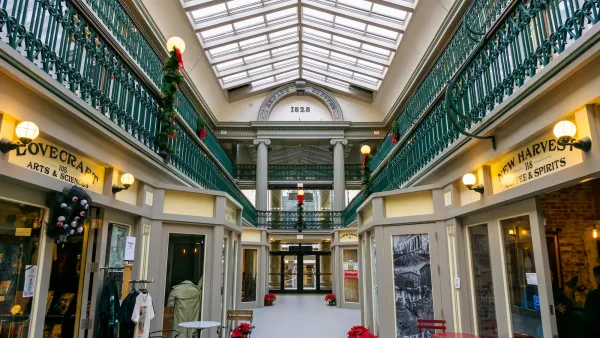
You Can Live Inside America’s Oldest Indoor Shopping Mall
The Arcade in Providence, Rhode Island, first built in 1828, was redeveloped into 48 micro-housing units.
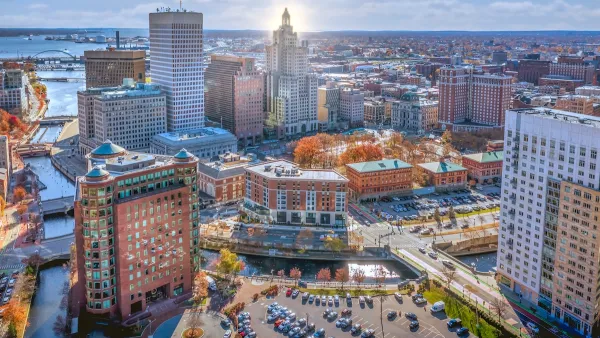
From Plan to Place: Providence’s Downtown Renaissance
Providence’s downtown is transforming from plan to place. Decades of strategic planning, zoning reforms, & investment are paying off, creating a more vibrant, walkable urban core. Here’s how thoughtful policy and design are shaping the city’s future.

Planetizen Federal Action Tracker
A weekly monitor of how Trump’s orders and actions are impacting planners and planning in America.

Amtrak, CN end decades-long dispute with eight-year agreement
The new operating agreement establishes an updated framework for the companies to work together, including processes to resolve disputes.

Judges permit Denver to divert 77,000 acre feet from the Colorado River for reservoir expansion
Overuse and climate change have caused the Colorado River’s water levels to plummet.

NYC DOT wants faster, more permanent street upgrades
The city is examining ways to build more concrete infrastructure without getting entangled in 'decades-long' projects.

'Something we’ve never seen before:' rising utility rates could strain city finances nationwide
Data centers, climate change and other factors have caused utility rates in the United States to increase by 38% since 2020.

Trump to overrule local leaders, lease millions of acres of America’s Pacific Island territories’ seafloors to mining companies
International law says that the Indigenous people of America’s territories have a right to prior and informed consent regarding projects that impact their countries.

FREE Course: Walkable City 1: Why Walkability?
After describing his path towards focusing on walkability as the essence of good planning, Jeff Speck marches through his five principal reasons for making more walkable places.
Reinventing Malls: Planning Alchemy—Turning Gray Fields Into Gold
The course focuses on the opportunities and imperatives that shape reinvention of mall sites.

Harvard University Graduate School of Design
KFH Group Inc.
Greater Baltimore Committee
The Architects Foundation
University of Cincinnati Online
The Pocatello Development Authority
The Urban Renewal Agency of the City of Pocatello