Florida Southern College, the National Register-listed campus that features "the largest concentration of [Frank Lloyd] Wright designed structures anywhere in the world," has found an impressive way to house its feral cats.


Archinect brings us news from the National Register-listed campus in Lakeland, Florida, which has enlisted Mesick Cohen Wilson Baker Architects to devise an elegant solution for housing its 100 feral cats. According to Eric Pera, with The Ledger, the campus is proceeding with plans to construct six "domiciles built mostly of custom-made concrete blocks will provide shelter for almost 100 feral cats living on the Lakeland campus." The designs for the 5 feet high and 3 feet wide structures are "inspired by the famed architect."
"It would be incorrect to call them cat houses, college officials say. The preferred terminology is cat cafe, a place where the wayward felines can kick back for a drink and some chow."
"The cafes, designed by a New York architectural firm that has done renovation work on several Wright buildings at FSC, will double as shelter. The Alpha Chi Omega sorority will supply food and watch over the cats in partnership with SPCA of Florida as part of its commitment to control Polk County's feral cat problem."
Read the full story: Florida Southern's College's Stray Cats Getting Own Frank Lloyd Wright Styled Dorms

8 Frank Lloyd Wright Buildings Named World Heritage Sites
Eight buildings designed by Frank Lloyd Wright are the first works of U.S. modern architecture to be named UNESCO World heritage sites.
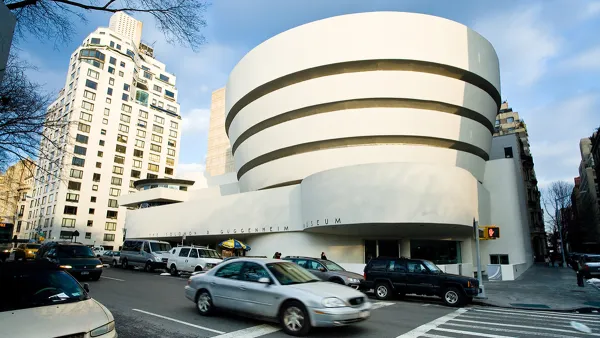
8 Frank Lloyd Wright Buildings Nominated as UNESCO World Heritage Sites
If accepted as UNESCO World Heritage sites, the eight Frank Lloyd Wright buildings would be the first examples of modern architecture in the United States included in that august company.
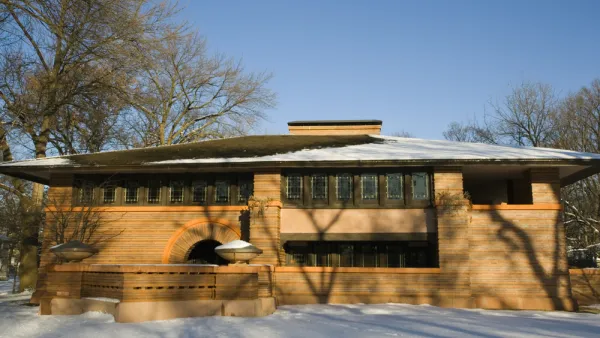
National or Regional? Finding American Identity in Architecture
In an extended discussion, Keith Eggener examines what it means for a work of architecture to be "naturally" American, and why looking at modern American styles through an intensively regional lens may be unhelpful.

Planetizen Federal Action Tracker
A weekly monitor of how Trump’s orders and actions are impacting planners and planning in America.

California plans to bury El Niño’s downpour
If the state plays its cards right, it may be able to store a billion acre-feet of El Niño’s water in aquifers.

Desperate measures: Advocates weigh draining Lake Powell to fill Colorado River
Draining the reservoir could reduce evaporation losses by a couple hundred thousand acre-feet.

Mamdani’s pied-à-terre tax survives legal challenge
A panel of judges found that the plaintiffs failed to demonstrate injury as a result of New York City's implementation of the tax.

Eastern Nebraska is running out of electricity
Data centers and electrification are straining eastern Nebraska’s grid, throttling economic development.

Seattle passes record-breaking transit services expansion
Proposition 1 will double the city’s transit tax to add 95,000 more bus trips and preserve 180,000 bus trips annually.

FREE Course: Walkable City 1: Why Walkability?
After describing his path towards focusing on walkability as the essence of good planning, Jeff Speck marches through his five principal reasons for making more walkable places.
Reinventing Malls: Planning Alchemy—Turning Gray Fields Into Gold
The course focuses on the opportunities and imperatives that shape reinvention of mall sites.

City of Rosemead
Rutgers University, Edward J. Bloustein School of Planning and Public Policy
One Hundred Miles
Hunter College, City University of New York (CUNY)
The Architects Foundation
University of Cincinnati Online
City of Cambridge
Montrose County
The Pocatello Development Authority