This week, the website Walk Score announced the results of its expanded Bike Score evaluation. With more than double the amount of cities than initially ranked, the usual favorites (Minneapolis, Portland), were joined by some surprises.



"Compiled from a data set that includes bike infrastructure, hilly terrain, number of bikers on streets and more," Bike Score has expanded their evaluations to 25 U.S. cities and 11 Canadian cities following the new metric's launch in May. The additional cities surveyed were selected as a result of voting conducted during National Bike Month. As Jocelyn Milici Ceder at Walk Score notes, "[t]he top 10 voted on cities (for which we could obtain bike data) plus 5 additional cities are now scored."
Even with the expanded rankings, no U.S. city was deemed worthy of the top category of "biker's paradise." There has been movement at the top of the rankings, however. Boulder is the new top bikeable city with a score of 86. Minneapolis, who topped the initial list, fell to second place, and Portland, whose score of 70 was enough to earn it second place in the inagural rankings fell all the way to seventh place. Fort Collins, Ann Arbor, Eugene, and Tempe all received higher scores than what some consider to be America's best bike city.
Read the full story: A Few Surprises in New Bike Scores

What Are the Most Bikeable Cities?
The folks behind Walk Score, the incredibly popular walkability measure, are beta testing a new metric that judges the bikeability of cities, writes Jess Zimmerman.
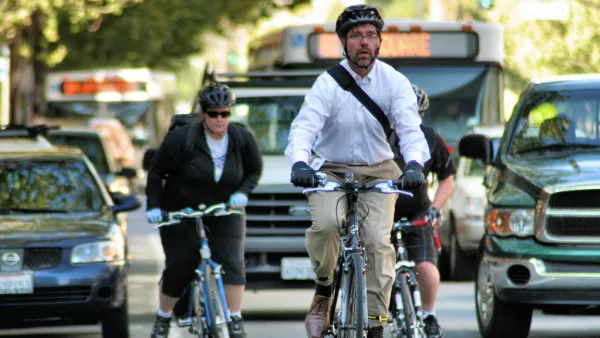
154 Cities Earn Marks in Updated Bike Score Rankings
Walk Score released an updated ranking of the best cities for biking—including Bike Scores for a total of 154 U.S. cities—in time for Bike to Work Week and National Bike Month.
Cycling Renaissance Races Across America
From coast to coast, cities across the United States are experiencing a rise in bicycling. Local governments are leading the peloton, with cycle-friendly policies and increases in government funding spurring a municipal pedal pursuit.

Planetizen Federal Action Tracker
A weekly monitor of how Trump’s orders and actions are impacting planners and planning in America.

Chicago breaks ground on $3 billion megadevelopment
The new neighborhood, titled Foundry Park, will one day host 3,700 residences.

This MA town is drowning in its own sewage — and residents like it that way
Susan Murcott, a waste water expert, said if Carlisle didn't address their leaking sewage, the problem could turn “deadly.”

Iowa taxpayers are paying thousands to clean manure out of their water
While the Clean Water Act makes states responsible for regulating factory farms that discharge pollutants, Iowa has turned a blind eye to the polluting farms.

Amtrak cuts ribbon on Seattle Airo maintenance facility
The $250 million, nearly 100,000-square-foot building can house an entire Cascades Airo trainset.

To power data centers, Google seeks autonomous control of thousands of homes’ electricity
The tech company has signed a deal to indirectly pay Mid-Atlantic residents to reduce their power demand when the grid is strained.

FREE Course: Walkable City 1: Why Walkability?
After describing his path towards focusing on walkability as the essence of good planning, Jeff Speck marches through his five principal reasons for making more walkable places.
Reinventing Malls: Planning Alchemy—Turning Gray Fields Into Gold
The course focuses on the opportunities and imperatives that shape reinvention of mall sites.

City of Rosemead
Rutgers University, Edward J. Bloustein School of Planning and Public Policy
One Hundred Miles
The Architects Foundation
University of Cincinnati Online
Montrose County
The Pocatello Development Authority
The Urban Renewal Agency of the City of Pocatello