Electric-car-battery manufacturer A123 Systems received $249 million in federal grants. It filed for bankruptcy on Oct. 16, prompting Bloomberg reporter Angela Greiling Keane to look at the progress of President Obama's goal of 1 million EVs by 2015


Keane's piece focuses not so much on the A123 Systems bankruptcy as much as it does the lack of progress on meeting Obama's goal. However, since President Obama's green energy goals have become a campaign issue, this latest 'Solyndra-like' bankruptcy provides fodder for the Romney/Ryan ticket.
"President Obama has put $5 billion in taxpayer money behind his goal of having 1 million electric cars on U.S. roads by 2015. The Republican presidential ticket says it's money wasted on "losers"... (C)ar buyers so far haven't embraced electric vehicles in numbers close to Obama's goal. Electric-vehicle sales since 2011 totaled fewer than 50,000 through September, just 5 percent of the president's target", Keane writes.
"Obama's $5 billion investment in electric cars includes loans and grants to car and battery producers, spending on charging stations and $7,500 tax credits to car buyers. Recipients of loans and grants include Nissan Motor Co., which got a $1.4 billion loan to build the Leaf and its battery pack in the United States; Fisker Automotive, which Republican Paul Ryan criticized in last week's vice presidential debate for building its first model in Finland; Tesla Motors; and A123 Systems Inc., the battery maker that filed for Chapter 11 bankruptcy protection (Oct. 16)."
Despite its auspicious start in 2010, Nissan Leaf sales have been disappointing. According to the Sept. 4 Detroit News, "Nissan Motor Co. said it sold just 685 Leafs in August, down 50 percent from August 2011. For the year, Nissan has sold 4,228, down 31.5 percent." While GM's Volt sales have been much higher, large inventories caused extended halts in production of the plug-in electric vehicle that can also run on gasoline, unlike the Leaf that is only runs on battery power.
Brett Smith, co-director of manufacturing, engineering and technology at the Center for Automotive Research in Michigan was not optimistic on American acceptance of electric cars. "(The business model) isn't there yet for volume. It isn't there yet for reaching the mass consumer. And it probably isn't going to be there for a while."
In addition, a Congressional Budget Office report, "Effects of Federal Tax Credits for the Purchase of Electric Vehicles", questions the efficacy of the $7500 federal credit for new purchases of electric vehicles.
For example, the CBO report states, "Increased sales of electric vehicles allow automakers to sell more low-fuel-economy vehicles and still comply with the federal standards that govern the average fuel economy of the vehicles they sell (known as CAFE standards). Consequently, the credits will result in little or no reduction in the total gasoline use and greenhouse gas emissions of the nation's vehicle fleet over the next several years."
Read the full story: Electric car sales falling short of goal

Electric Vehicles Are Money Losers, But That's Expected
All-electric vehicles - those without tailpipes or gas tanks, are entering the marketplace, particularly in California, but unlike other models from the same manufacturers, they are not expected to sell well. So why are they even being manufactured?
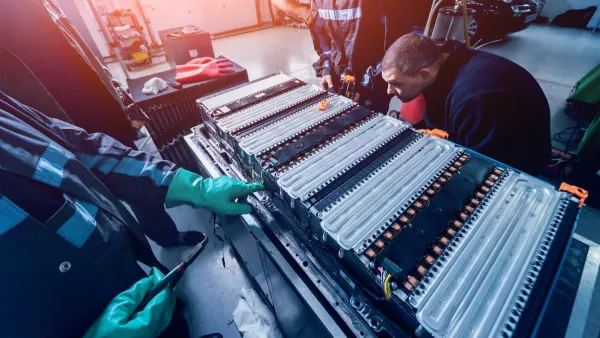
Used EV Batteries Get New Life Supporting the Texas Power Grid
After the end of their useful life in electric cars, batteries can be repurposed to stabilize the electricity supply.
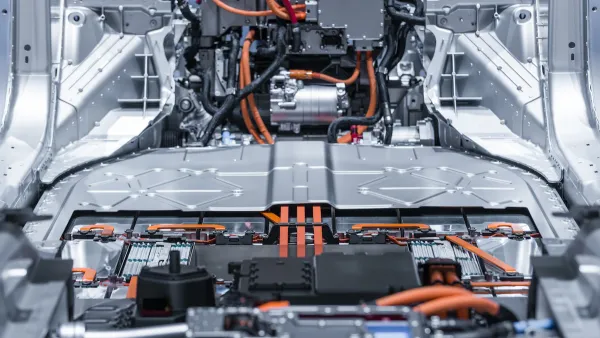
Industry Leaders: Automakers Must Cut EV Battery Weight in Half
Experts call for lighter batteries, diversification of fuels, and a shift away from private cars and towrad public transit.

Planetizen Federal Action Tracker
A weekly monitor of how Trump’s orders and actions are impacting planners and planning in America.

California plans to bury El Niño’s downpour
If the state plays its cards right, it may be able to store a billion acre-feet of El Niño’s water in aquifers.

Chicago breaks ground on $3 billion megadevelopment
The new neighborhood, titled Foundry Park, will one day host 3,700 residences.

Want to study the Missouri River? Soon, you may need unanimous approval from 10 states
Legislation would require 10 governors’ permission to study or build projects moving water outside the basin.

Desperate measures: Advocates weigh draining Lake Powell to fill Colorado River
Draining the reservoir could reduce evaporation losses by a couple hundred thousand acre-feet.

This road in NYC is infamously dangerous — and Mamdani can't fix it
New York City's Ocean Parkway is known for reckless driving, but the power to implement safety measures lies with the state rather than the city.

FREE Course: Walkable City 1: Why Walkability?
After describing his path towards focusing on walkability as the essence of good planning, Jeff Speck marches through his five principal reasons for making more walkable places.
Reinventing Malls: Planning Alchemy—Turning Gray Fields Into Gold
The course focuses on the opportunities and imperatives that shape reinvention of mall sites.

City of Rosemead
Rutgers University, Edward J. Bloustein School of Planning and Public Policy
One Hundred Miles
Hunter College, City University of New York (CUNY)
The Architects Foundation
University of Cincinnati Online
City of Cambridge
Montrose County
The Pocatello Development Authority