Author Kevin Baker offers a historical perspective of the Republican Party's shift to the "anti-urban party".


Under a mock news headline "Republicans to Cities: Drop Dead", author Kevin Baker offers the indictment that the Republican Party "still can't get seem to get past its animus toward the very idea of urban life."
Looking back to the 1970's, Baker reflects on how Republicans let cities become centers of for the Democratic Party: "For Republicans, cities now became object lessons on the shortcomings of activist government and the welfare state - sinkholes of crime and social dysfunction, where Ronald Reagan's "welfare queens" cavorted in their Cadillacs. The very idea of the city seemed to be a thing of the past, an archaic concept -- so much so that Gerald R. Ford seriously considered letting New York go bankrupt in 1975.
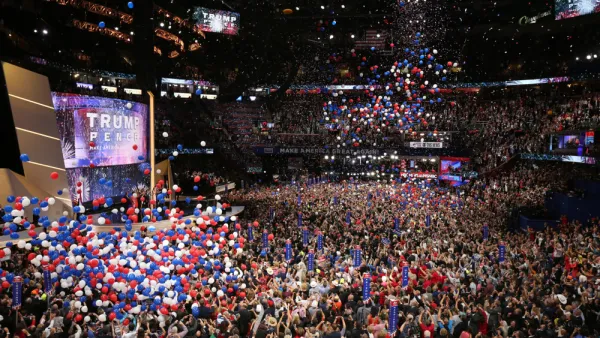
Baker observes that cities were barely mentioned in the Republic convention or by the Republican platform committee, and suggests that the Republican leadership is not, essentially, urban. "Unsurprisingly, the chairman of the Republican platform committee, Gov. Bob McDonnell of Virginia, is from a state that has no city with a population of 500,000 or more. One of his two "co-chairmen" was Senator John Hoeven of North Dakota, which ranks 47th among the states in population density. The other was Marsha Blackburn, who represents a largely suburban district of Tennessee."
"Republicans may not want to go to the cities. But that doesn't much matter. The cities are coming to them," concludes Baker. Kevin Baker is the author of the City of Fire series of historical novels.
Read the full story: How the G.O.P. Became the Anti-Urban Party

Floridians File Lawsuit to Protect Jacksonville from the GOP
A public nuisance lawsuit filed July 8 aims to ensure that an unsafe indoor mass gathering like President Trump held in Tulsa last month, which reportedly led to coronavirus infections, does not occur during the Republican National Convention.

Large Cities Were Already Losing Population. Then Came the Coronavirus.
"Cities of all sizes may soon look less alluring, if drastic drops in income, sales and tourism tax revenue leave gaping holes in budgets," according to this article, which encapsulates a popular school of thought as the pandemic rages.

How Cities and Communities Can Rebound From the Pandemic
An interview with Michael Berkowitz, former executive director of 100 Resilient Cities, finds a path to the light at the end of the tunnel.

Planetizen Federal Action Tracker
A weekly monitor of how Trump’s orders and actions are impacting planners and planning in America.

Chicago breaks ground on $3 billion megadevelopment
The new neighborhood, titled Foundry Park, will one day host 3,700 residences.

This MA town is drowning in its own sewage — and residents like it that way
Susan Murcott, a waste water expert, said if Carlisle didn't address their leaking sewage, the problem could turn “deadly.”

Iowa taxpayers are paying thousands to clean manure out of their water
While the Clean Water Act makes states responsible for regulating factory farms that discharge pollutants, Iowa has turned a blind eye to the polluting farms.

Amtrak cuts ribbon on Seattle Airo maintenance facility
The $250 million, nearly 100,000-square-foot building can house an entire Cascades Airo trainset.

To power data centers, Google seeks autonomous control of thousands of homes’ electricity
The tech company has signed a deal to indirectly pay Mid-Atlantic residents to reduce their power demand when the grid is strained.

FREE Course: Walkable City 1: Why Walkability?
After describing his path towards focusing on walkability as the essence of good planning, Jeff Speck marches through his five principal reasons for making more walkable places.
Reinventing Malls: Planning Alchemy—Turning Gray Fields Into Gold
The course focuses on the opportunities and imperatives that shape reinvention of mall sites.

City of Rosemead
Rutgers University, Edward J. Bloustein School of Planning and Public Policy
One Hundred Miles
The Architects Foundation
University of Cincinnati Online
Montrose County
The Pocatello Development Authority
The Urban Renewal Agency of the City of Pocatello