A public nuisance lawsuit filed July 8 aims to ensure that an unsafe indoor mass gathering like President Trump held in Tulsa last month, which reportedly led to coronavirus infections, does not occur during the Republican National Convention.


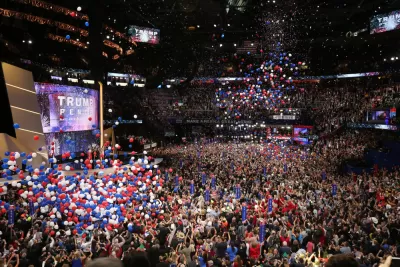
The lawsuit comes just days after Florida, one of the nations' top coronavirus hotspots, saw the nation's highest number of daily cases since April 15. On Sunday, the state set a new record with 15,300 new cases, blowing past New York's record of 12,274 set on April 4. The state has a test positivity rate of 19.6% on July 12, second-highest after Arizona, according to the COVID Exit Strategy, although the Miami Herald reports the 7-day average as 14.2%.
"We have to take the action because if the Republican National Convention comes to Jacksonville and conducts itself the way it did in Tulsa, we will have a catastrophic super spreader again in the city that will cause immeasurable sickness and death to our community," W.C. Gentry, the lead counsel for a group of local residents, business owners and attorneys who filed the lawsuit [pdf] in Duval County Circuit Court, told Brianna Keilar, a CNN host, on July 10.
Under Florida law, Chapter 60 Statute that was passed back in 1917, a citizen of the State of Florida and the county can bring a cause of action to enjoin a public nuisance, which is something that will injure the public, and this clearly will injure the public, and so we sought to have it enjoined.
In addition to the Republican National Committee (RNC), defendants include the city of Jacksonville, the most populous in the state; the Donald Trump 2020 presidential campaign; and ASM Global which manages the VyStar Veterans Arena where President Trump is scheduled to deliver his acceptance speech next month.
Convention wasn't intended for Jacksonville
"The convention is slated for August 24-27 in Jacksonville and Charlotte, North Carolina," reported Kate Sullivan for CNN on June 29. However, because North Carolina chose to "stand by coronavirus measures," an alternative venue was selected for President Trump's acceptance speech.
The party moved parts of the convention out of Charlotte after Trump said the state's Democratic governor was "unable to guarantee" that the arena where the convention was to be held could be filled to capacity. Gov. Roy Cooper maintained that the state of the pandemic would dictate whether Republicans were able to fully gather.
Cooper's office said Trump had called the governor and insisted on a full convention with no face masks or social distancing, and that Cooper expressed concern and suggested a scaled-back event.
A reference to Charlotte is included in the lawsuit, reports Sky Lebron for WJCT News, Jacksonville's NPR affiliate, in the source article.
“Indeed, Defendant RNC moved the Convention from Charlotte, North Carolina to Jacksonville because the State of North Carolina would not accede to its and Mr. Trump’s demands that they be permitted to pack thousands of persons into the convention facilities, in close proximity and in a closed space in violation of safe COVID-19 health practices,” the suit reads.
Not intended to stop the convention from coming to Jacksonville.
The purpose of the lawsuit is to ensure that the Republican conventions abide by the Centers for Disease Control and Prevention guidelines for mass gatherings.
“To avoid community spread of COVID-19 and to protect the health and welfare of Plaintiffs and the community, it is necessary and essential that all super spreader events where large numbers of people congregate in close proximity indoors not occur,” the suit reads.
As the CDC guidelines indicate, outdoors is lower risk than indoors, but being guidelines and not rules, it indicates what is necessary for indoor gatherings. Gentry shared that guidance with CNN viewers.
"If they want to have a convention and not cause a lot of the attendees to become sick and die and our community to be severely damaged, they have to do it either outdoors or if they do it indoors, with a very small number of people, with social distancing, with mask," he told Keilar.
"And they made it clear they want to come here, they want to have their convention. And so we're saying, if you're going to do it, you have to do it safely to protect our community."
"The lawsuit demands that if the event still takes place, it be limited to 'no more than 2,500 persons; that at least 12,500 seats of the arena be isolated or roped off, or such number as necessary to provide a seated distance of at least six feet between each person,'” adds Lebron.
Already yielding results
Josh Dawsey of The Washington Post reported on July 9 that the RNC is already considering outdoor venues.
While no decision has been made, Republican officials are studying two outdoor professional sports stadiums near the VyStar Veterans Memorial Arena where the convention is currently slated to be held. They are also looking more broadly into the logistics of pulling off an outdoor convention, according to two Republicans involved in the planning.
Gentry made it clear that even if outdoors, CDC guidelines must be followed: "If you have it outdoors, people [must] be distanced at least six feet apart and that they wear masks."
Mask mandates not enough
The city of Jacksonville passed a mandatory mask ordinance on June 29, noted Sullivan of CNN, but there's always a question of enforcement and exemptions. While President Trump wore a mask during his visit to wounded service members at Walter Reed National Medical Center on Saturday, he did not wear a mask on Friday during his visit to Miami-Dade County.
"Trump was exempted from a Miami-Dade County mask-wearing mandate thanks to carve-outs in the emergency order for churches and properties under federal jurisdiction," reported the Miami Herald. "At Miami International Airport, where the order does apply to the general public, Trump did not have to don a facial covering..."
Correspondent's commentary on litigation
There's irony in the lawsuit's reliance on the CDC guidelines to ensure that the mass gathering planned for Jacksonville next month will be safe. Food and Drug commissioner Stephen Hahn was asked by host Dana Bash on CNN’s “State of the Union" on July 4 whether Florida will be a safe place for the Republican National Convention next month amid a surge in Covid-19 cases there.
“I think it’s too early to tell,” Hahn, a member of the White House Coronoavirus Task Force, responded. “We’ll have to see how this unfolds in Florida and around the country.”
Hahn works with CDC Director Robert Redfield on that task force. He could have referred to those guidelines. Sadly, it's up to private citizens to ensure they are followed.
Related in Planetizen:
-
The U.S. in Free Fall, July 7, 2020
-
Model Predicts Next U.S. Coronavirus Epicenter, June 22, 2020
Other pandemic lawsuits:
-
Justice Department Challenges Hawaii Quarantine, June 29, 2020
-
NIMBY Politics Sway the Fight to Contain Coronavirus, March 4, 2020
FULL STORY: Local Attorney Files Lawsuit Against City For Hosting RNC

Mask Mandates Without Enforcement Amount to Half-Measures
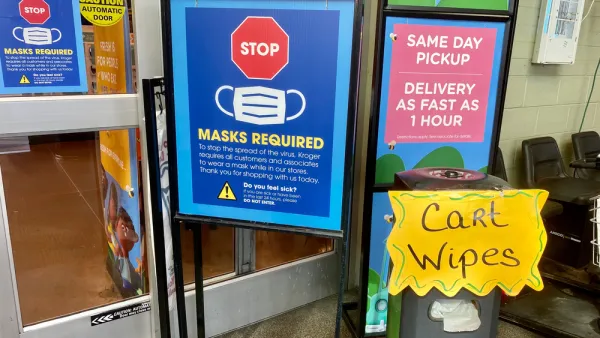
Issuing a ticket to a pedestrian for not wearing a mask in Miami is like issuing a ticket to a motorist for not wearing a seatbelt, states a specially-detailed Miami police officer. Welcome to the "new normal" in this coronavirus hotspot.
Religion in the Pandemic: First Amendment vs. Public Health and Safety
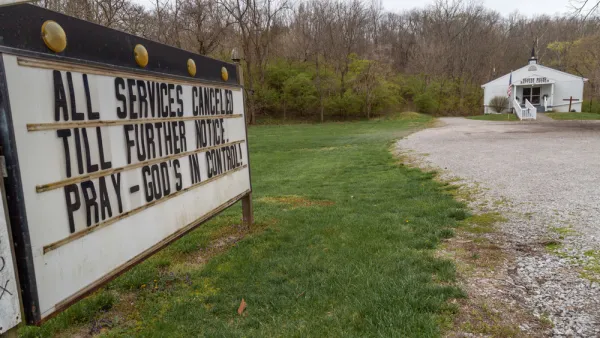
Conflicts between church and state are being decided in state and federal courts as governors act to protect their constituents from the coronavirus while religious institutions and their supporters seek exceptions from social gathering restrictions.
After Waiting Two Days, Justice Department Appeals Transit Mask Ruling
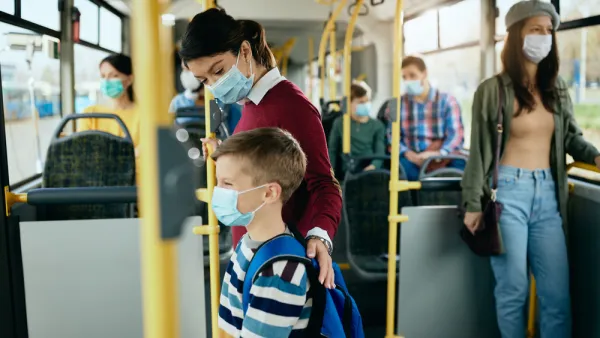
Mystery surrounds the decision by the Biden administration to not ask for an immediate stay of an unanticipated district court ruling to vacate the CDC's masks-on-transit rule. Two days later they appealed as coronavirus cases increase nationwide.

The state-sanctioned urbicide of Austin
People don’t kill cities. Freeways do.

US to reduce Colorado River water deliveries to Mexico
A new Colorado Treaty amendment reduces Mexico’s Colorado River water allocation by 250,000 acre feet.

New Jersey’s second-largest city bans standalone data centers
Jersey City will continue to allow co-location facilities, such as those meant for research institutions that store their own data.

Amtrak not solely to blame for New Jersey commuter rail's unreliability, report finds
A new study from the Garden State Initiative found that NJ Transit’s budget grew 20% across a 4 year period, but reliability declined significantly over the same period.

EPA erases limits on planet-warming pollution from power plants
Under Monday’s plan, power plants would still have some limits on how much mercury, arsenic and other contaminants they can emit.

Phoenix announces new on-demand transit service, more frequent RAPID buses
Both new services will launch in October, and are part of Phoenix's Project Effective Access Solutions for Easing Congestion.

FREE Course: Walkable City 1: Why Walkability?
After describing his path towards focusing on walkability as the essence of good planning, Jeff Speck marches through his five principal reasons for making more walkable places.
Reinventing Malls: Planning Alchemy—Turning Gray Fields Into Gold
The course focuses on the opportunities and imperatives that shape reinvention of mall sites.

Eagle County Government
Harvard University Graduate School of Design
Nashville Planning Department
The Architects Foundation
University of Cincinnati Online
The Pocatello Development Authority
The Urban Renewal Agency of the City of Pocatello
Journal of the American Planning Association