Long Beach's Press Telegram explores the options for completing a 4.5-mile stretch of the Long Beach (710) Freeway connecting Alhambra to Pasadena, a controversy that's been brewing for five decades.


As Metro considers widening the 710 freeway at its southern end, and options for closing the 4.5-mile gap at its northern end, Lauren Gold, Steve Scauzillo, Karen Robes Meeks and Brian Charles look at the pros and cons of L.A.'s next major multi-billion dollar freeway construction project.
"A [$3.5 billion] freeway tunnel, a light-rail line, a bus line, and a high-tech transportation management system, which coordinates traffic lights and automobile flow" are among the options being considered for completing the nothern end of the Long Beach (710) Freeway and filling in the 'missing link' in Southern California's 22,000-mile transportation system.
"Opponents believe any proposal for the 710 results in the destruction of neighborhoods and a reduced quality of life," write the authors.
"We look at ourselves; we're fighting the Port of Los Angeles and we're fighting the 710," Long Beach resident John Cross said. "We're like David and Goliath, only my deal is we should just find the right rock to hit them with. We're gonna keep chucking rocks."
Read the full story: The 710: Spine of LA Freeway system and its missing link
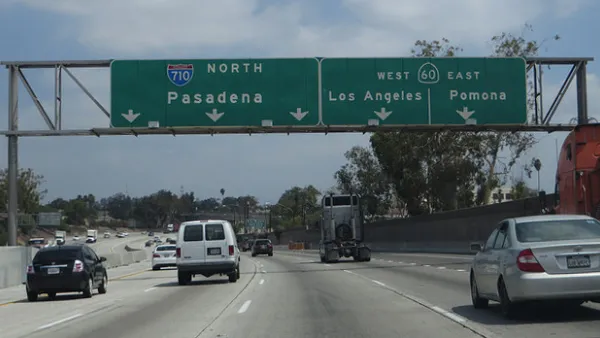
With a 710 Freeway Extension Unlikely, Cities Propose Alternatives
After withdrawing support for a controversial extension of the 710 Freeway, Los Angeles Metro is asking cities for local road improvements to improve traffic flow in its stead.
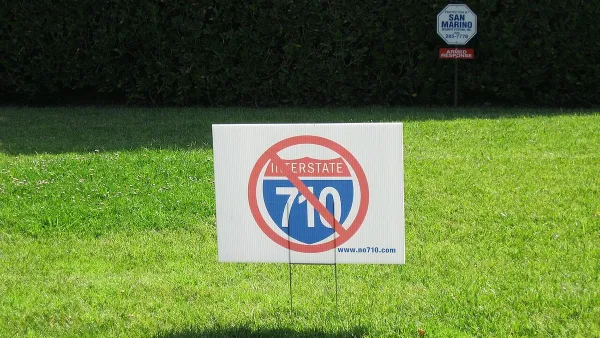
LA Metro Board Approves New 710 Freeway Plan
The newest plan for the 710 corridor claims it will not displace any residents.
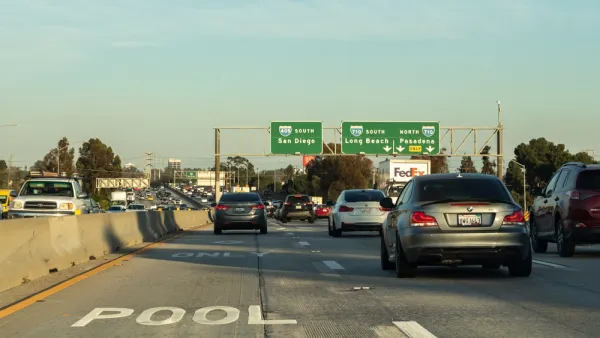
Southern California Freeway Expansion Plans Scrapped
After more than a decade of planning, Caltrans has officially dropped the I-710 Corridor Project, a plan to widen Interstate 710 for a long stretch of the freeway near the ports of Los Angeles and Long Beach.

Planetizen Federal Action Tracker
A weekly monitor of how Trump’s orders and actions are impacting planners and planning in America.

Eastern Nebraska is running out of electricity
Data centers and electrification are straining eastern Nebraska’s grid, throttling economic development.

Study reveals best places in the U.S. for cycling, walking
New research from Streetlight Data examines bicycle and pedestrian miles per capita in the 100 largest U.S. cities by population.

DSA members accuse Mamdani of 'abandoning values' over housing redevelopment
New York City's mayor plans to replace about 2,000 units of public housing with private, mixed-income housing.

All sides of BRT debate unhappy with CDOT’s most recent move
The Colorado Department of Transportation is no longer considering center-running bus lanes for Colorado Boulevard.

Massachusetts bogs generate both power, and cranberries
Putting solar panels above farmland is one way Massachusetts is advancing toward its goal of net-zero carbon emissions by 2050.

FREE Course: Walkable City 1: Why Walkability?
After describing his path towards focusing on walkability as the essence of good planning, Jeff Speck marches through his five principal reasons for making more walkable places.
Reinventing Malls: Planning Alchemy—Turning Gray Fields Into Gold
The course focuses on the opportunities and imperatives that shape reinvention of mall sites.

City of Rosemead
Rutgers University, Edward J. Bloustein School of Planning and Public Policy
One Hundred Miles
University of Michigan School for Environment and Sustainability (SEAS)
Hunter College, City University of New York (CUNY)
The Architects Foundation
City of Cambridge
The Pocatello Development Authority
The Urban Renewal Agency of the City of Pocatello