Sam Lubell reports on the proposed designs for a new Sixth Street Viaduct in Los Angeles, which incorporate Angelenos' hopes for a more walkable and park-friendly future.


In searching for Los Angeles' "next major icon", the city's Bureau of Engineering has called on three design and engineering teams to fully redesign the Sixth Street Viaduct. The competition called for a "$400 million, cable stayed structure."
The three agencies -- HNTB, AECOM, and Parsons Brinckerhoff -- each submitted distinct designs that "not only showcased memorable forms, but embraced people-friendly designs, including pedestrian paths, parks, and connections to the river below."
Though varying in material and form, each of the designs provide lookout points, pedestrian walkways and access to parks below, a priority for Mayor Villaraigosa who refers to the city as "park poor." According to the mayor, the new bridge is a starting point for Angelenos to "reimagine the city as a place where people can work, play, and recreate."
The winning design will be chosen at the end of this year, and construction is slated to be completed in 2018.
Read the full story: Visions of Sixth Street

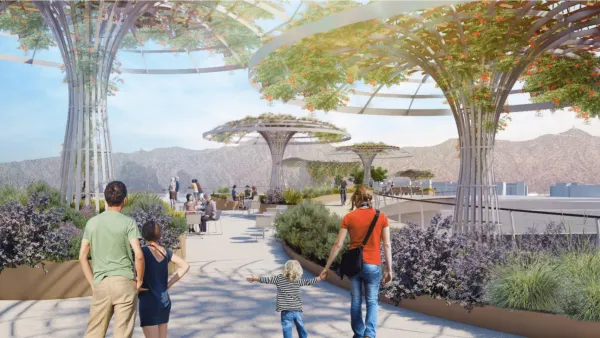
'Transformative' pedestrian bridge planned for LA River in Glendale Narrows
A new bridge will link Griffith Park and the Glendale Narrows Riverwalk.
Annual LA River CleanUp Invites Residents to Protect Local Ecosystems
The Friends of the Los Angeles River will host its 34th Annual LA River CleanUp on October 5, inviting residents to help beautify the river, prevent litter from reaching the ocean, and promote equitable access to green spaces.
Revitalizing Sepulveda Basin: A Green Vision for An Urban Oasis
Developed through the input of thousands of community members, this is the first comprehensive plan by the City of Los Angeles for the 2,000-acre basin.

Planetizen Federal Action Tracker
A weekly monitor of how Trump’s orders and actions are impacting planners and planning in America.

California plans to bury El Niño’s downpour
If the state plays its cards right, it may be able to store a billion acre-feet of El Niño’s water in aquifers.

Chicago breaks ground on $3 billion megadevelopment
The new neighborhood, titled Foundry Park, will one day host 3,700 residences.

Satanic place names
From streams and lakes to valleys and canyons, I mapped more than 1,000 places named after the Devil.

California High-Speed Rail Authority CEO resigns after $600,000 scandal
Under Ian Choudri, the authority used taxpayer dollars to fund first class flights and trips to nightclubs.

Want to study the Missouri River? Soon, you may need unanimous approval from 10 states
Legislation would require 10 governors’ permission to study or build projects moving water outside the basin.

FREE Course: Walkable City 1: Why Walkability?
After describing his path towards focusing on walkability as the essence of good planning, Jeff Speck marches through his five principal reasons for making more walkable places.
Reinventing Malls: Planning Alchemy—Turning Gray Fields Into Gold
The course focuses on the opportunities and imperatives that shape reinvention of mall sites.

City of Rosemead
Rutgers University, Edward J. Bloustein School of Planning and Public Policy
One Hundred Miles
Hunter College, City University of New York (CUNY)
The Architects Foundation
University of Cincinnati Online
City of Cambridge
Montrose County
The Pocatello Development Authority