Recently revealed estimates put far more people in the region at risk for catastrophic flooding than previously thought.


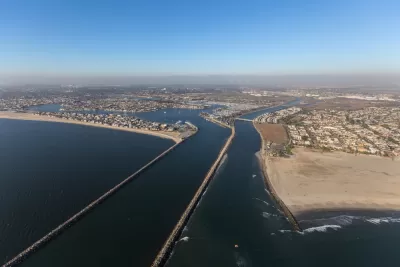
The Los Angeles County Board of Supervisors wants to know how to shore up the region’s flood control infrastructure as experts predict “an increase in epic downpours” that could pose significant flood risk to many L.A. communities. Louis Sahagún reports on the story for the Los Angeles Times.
The supervisors are calling for a report from the Department of Public Works (DPW) detailing the state of existing infrastructure and plans for improving it. The motion comes in response to a recent study that highlighted the disproportionate risk faced by low-income communities of color. “The study’s unprecedented combination of high-resolution flood modeling and socioeconomic data indicates that major floods would occur between the Dominguez Channel on the west and the Los Angeles River on the east,” Sahagún writes, noting that the analysis put roughly 874,000 people and as much as $108 billion in property at risk for catastrophic flooding.
“Until recently, it was thought that a flood event of that magnitude was likely to occur every 1,000 to 10,000 years. New research, however, suggests that the chances of seeing another one of that scale over the next 40 years are about 50/50.” This makes the urgency of upgrading flood control and mitigation infrastructure more severe than previously thought. According to Mark Pestrella, director and chief engineer of the Los Angeles County Flood Control District, “The Board’s action today aligns with the county’s sustainable plan to make infrastructure improvements that reduce flood risk, increase local water supplies through stormwater capture and groundwater recharge, and improve water quality across the county.”
FULL STORY: Los Angeles County seeks flood control improvements in face of climate change

The True Scale of Flood Hazard Facing Los Angeles
New research sheds light on how L.A.’s aging and poorly maintained infrastructure is putting hundreds of thousands more residents in flood hazard zones than previously estimated.
Chicago's underground flood control system is almost full
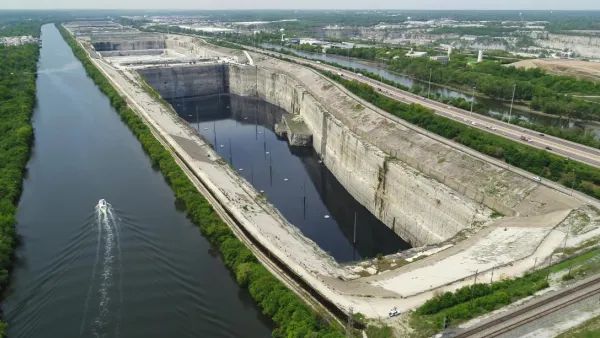
The system known as Deep Tunnel has never filled much more than halfway, but the cumulative effect of recent rains is putting suburban communities at risk of flooding.

Atlanta Flood Prevention Efforts are Causing ‘Climate Gentrification’ in its Black Communities
New infrastructure in neighborhoods that have borne the brunt of seasonal floods is making them safer — and more expensive.

Planetizen Federal Action Tracker
A weekly monitor of how Trump’s orders and actions are impacting planners and planning in America.

The state-sanctioned urbicide of Austin
People don’t kill cities. Freeways do.

US to reduce Colorado River water deliveries to Mexico
A new Colorado Treaty amendment reduces Mexico’s Colorado River water allocation by 250,000 acre feet.

Baltimore to break ground on $50 million Transit Priority Project
The project will bring faster bus trips, safer streets and better bike connections to Baltimore.

Airbnb launches $250 million 'last-dollar financing' housing accelerator, makes first investment in Austin
The company will put $6.4 million towards affordable housing development in Texas’ capital.

Guerilla urbanists are building DIY bus stop benches in Chicago
A before-and-after of one of the bus stops with a new bench. The new benches are not officially sanctioned or permitted, but the residents who placed them hope they will be the start of a network of DIY benches across the city.

FREE Course: Walkable City 1: Why Walkability?
After describing his path towards focusing on walkability as the essence of good planning, Jeff Speck marches through his five principal reasons for making more walkable places.
Reinventing Malls: Planning Alchemy—Turning Gray Fields Into Gold
The course focuses on the opportunities and imperatives that shape reinvention of mall sites.

Eagle County Government
Harvard University Graduate School of Design
Nashville Planning Department
The Architects Foundation
University of Cincinnati Online
The Pocatello Development Authority
The Urban Renewal Agency of the City of Pocatello
Journal of the American Planning Association