Chasing the widespread interest in city living, developers are exporting mixed-use urbanism to the suburbs and exurbs as "town center" projects, prompting Jonathan O’Connell to ask if "a city can be a city if it’s built in the middle of a cornfield."


Across America, builders are increasingly catching on to the value of the urban experience, and creating town center or "lifestyle center" projects (to the tune of 398 by the end of 2011) in suburbs, exurbs, and "on farmland alongside a highway." O'Connell looks at examples from around Washington D.C., such as the Village at Leesburg, where developers, "are aiming to replicate the culture and convenience of cities, minus their traffic and crime."
"Critics of town centers," contends O'Connell, "consider them soulless corporate replicas - no
more real cities than Disney World's fairy-tale fiberglass-and-concrete
showpiece is a real castle." As it becomes "harder to distinguish what makes a city a city," does it matter if every attempt to export mixed-use urbanism to the suburbs can't replicate the feel of Williamsburg in Brooklyn or U Street in D.C.?
"Developer and D.C. native Jair Lynch warned recently that suburban
city-like centers could steal the District's thunder. 'Just like the
suburbs kicked our butt on retail in the 1980s, that's exactly what's
going to happen with these transit-oriented, urban neighborhoods that
are coming up now,' he said." After all, says O'Connell, "At one point, even the most hardened and historic urban neighborhoods were shiny and new."
Developer Anthony Lanier, who "rebuilt Georgetown block by block," has a different perspective, however. "The feeling of walking down M Street in Georgetown or on U Street cannot
be duplicated, Lanier argues, because these areas were built not by a
developer with a singular vision but by time."
Read the full story: Can city life be exported to the suburbs?


Midburbs: A New Definition of Suburbs
When the name “suburb” just doesn't quite fit.

First Model Homes Revealed in Disney-Built Community
Disney’s Cotino, in the Southern California desert, is the first of the company’s ‘Storybook Living’ developments.
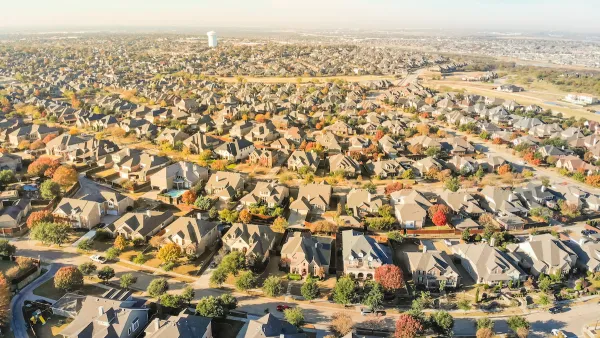
The Changing Shape of American Suburbs
Housing costs and availability are pushing more American households, including young families, to suburbs and exurbs — and they’re demanding changes.

Planetizen Federal Action Tracker
A weekly monitor of how Trump’s orders and actions are impacting planners and planning in America.

Amtrak, CN end decades-long dispute with eight-year agreement
The new operating agreement establishes an updated framework for the companies to work together, including processes to resolve disputes.

Northwest rail fans eager for Sept. 30 debut of Amtrak’s Airo fleet
Get ready for that new train smell and more seats. But they won’t go faster or run more frequently on the Cascades route in Washington and Oregon.

Brightline Florida files for bankruptcy
The transit company is over $5 billion in debt.

St. Louis Metro to test if single-car trains can reduce operating costs, maintain rider satisfaction
The pilot program will run from October to spring 2027, and begin with one single-car train operating on Metrolink’s Red and Blue lines.

Pennsylvania is building data centers in abandoned mines
Housing data centers in mines provides an alternative to destroying local forests and may spare residents from data centers’ noise and air pollution.

FREE Course: Walkable City 1: Why Walkability?
After describing his path towards focusing on walkability as the essence of good planning, Jeff Speck marches through his five principal reasons for making more walkable places.
Reinventing Malls: Planning Alchemy—Turning Gray Fields Into Gold
The course focuses on the opportunities and imperatives that shape reinvention of mall sites.

City of Thousand Oaks
City of Wisconsin Rapids
Harvard University Graduate School of Design
The Architects Foundation
University of Cincinnati Online
The Pocatello Development Authority
The Urban Renewal Agency of the City of Pocatello