"Model road" project in the Indian city of Ahmedabad has sidewalks, crosswalks, and on-street parking, but no street vendors.


Ending a long-simmering debate over the proper place for street vending on eight "model roads" the city is building, the Municipal Corporation of the Indian city of Ahmedabad this week determined that "hawkers," as street vendors are called there, would not be allowed on the new roads. Instead, they will be moved to special "hawker zones."
Cities throughout India are revamping their major roads to address the crippling congestion that has come from increased private vehicle use, and in the process struggling with the best way to design for pedestrians, cyclists, and, well, everything else that is not a car on Indian streets. Advocates of the model road project tout the pedestrian-friendly features of the project (primarily crosswalks and sidewalks, which in the past have often not been built on major thoroughfares), as well as innovations like marked on-street parking spots. Hawkers, however, did not fit into the mix.
The project has a Facebook page with photos of one of the implemented projects here: http://www.facebook.com/media/set/?set=a.194625757293819.44757.185296824893379&type=3
Thanks to Rachel Proctor May
Read the full story: No Hawkers on Model Roads?

The Climate Story You Might Have Missed
Surface temperatures reached 60 degrees Celsius (140 degrees Fahrenheit) in India and Pakistan at the end of April. Wet bulb temperature, the point at which the human body can no longer cool itself by sweating, is 35 degrees Celsius.
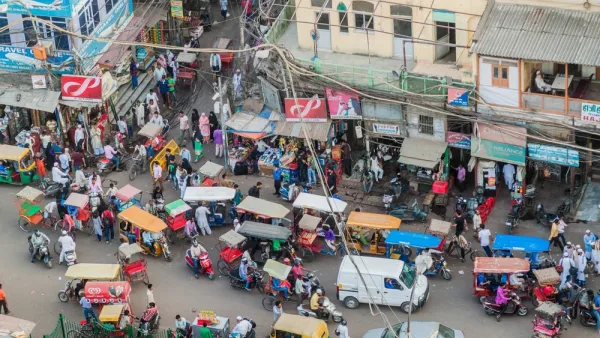
Experiencing Hyperdensity in Old Delhi
A tourist visit through the oldest, densest part of Delhi, India, reveals the chaos and beauty of hyperdensity.
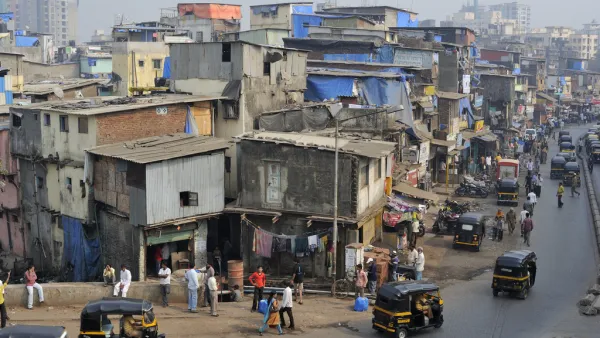
Are U.S. Homeless Worse Off Than India's Poor?
In photographs and written observations of a recent trip to Mumbai, India, former SPUR Director Jim Chappell queries how the lives of the poorest people there compare to the lives of low-income Americans.

Planetizen Federal Action Tracker
A weekly monitor of how Trump’s orders and actions are impacting planners and planning in America.

California plans to bury El Niño’s downpour
If the state plays its cards right, it may be able to store a billion acre-feet of El Niño’s water in aquifers.

Desperate measures: Advocates weigh draining Lake Powell to fill Colorado River
Draining the reservoir could reduce evaporation losses by a couple hundred thousand acre-feet.

Los Angeles just elected an urban planner as its mayor
Transportation analysts are optimistic that Raman will be more aggressive in addressing transit issues than Bass.

Mamdani’s pied-à-terre tax survives legal challenge
A panel of judges found that the plaintiffs failed to demonstrate injury as a result of New York City's implementation of the tax.

Eastern Nebraska is running out of electricity
Data centers and electrification are straining eastern Nebraska’s grid, throttling economic development.

FREE Course: Walkable City 1: Why Walkability?
After describing his path towards focusing on walkability as the essence of good planning, Jeff Speck marches through his five principal reasons for making more walkable places.
Reinventing Malls: Planning Alchemy—Turning Gray Fields Into Gold
The course focuses on the opportunities and imperatives that shape reinvention of mall sites.

City of Rosemead
Rutgers University, Edward J. Bloustein School of Planning and Public Policy
One Hundred Miles
University of Michigan School for Environment and Sustainability (SEAS)
Hunter College, City University of New York (CUNY)
The Architects Foundation
City of Cambridge
Montrose County
The Pocatello Development Authority