Sixty percent of premature deaths are accounted for not by medical care or lack thereof, but by social circumstances, environmental conditions, and behavioral patterns. So perhaps the medical field on its own can't prevent them.


Increasingly, studies highlighting one's zip code as a major social determinant of health are opening up the conversation between the community development and health sectors. But talking isn't enough. Until recently, the two sectors have worked in parallel worlds. In their Shelterforce piece, David Erickson and Nancy O. Andrews push for the health sector to see the community development field as a partner in its fight for better health for all-and vice versa.
The community development field's interaction with health is often indirect-increasing access to safe neighborhoods, jobs, and affordable housing options all have long term effects on the stress and wellness of people. There are ways for the two sectors to directly work together, however, including coming together to make federally qualified health centers the bridge between hospital clinics and community development financial institutions. The fields must tap into these opportunities for collaboration to achieve success at a large scale.
Thanks to Brittany Stanley
Read the full story: Better Together

Meeting on Common Ground: Community Development and Health Philanthropy Working Together
Often times, the community development field and health philanthropy have worked in the same neighborhoods, but separately. This is changing, and the Robert Wood Johnson Foundation’s (RWJF) Marjorie Paloma told Shelterforce how.
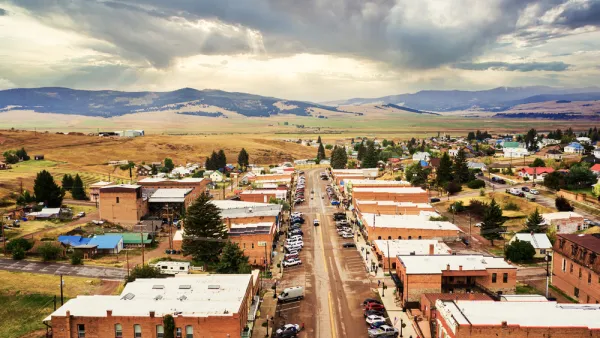
Study: Urban US Residents Have Higher Life Expectancy Than Rural Americans
A combination of economic and social factors leads to higher rates of disease and reduced access to healthcare for many rural residents.
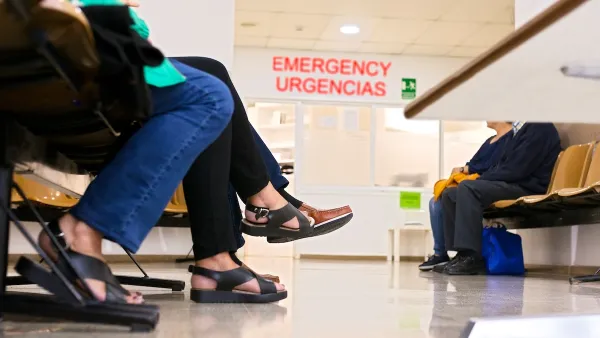
Maryland Assistance Program Links Housing and Healthcare
The state will begin funding an existing program that targets the healthcare needs of people experiencing or at risk of homelessness.

Planetizen Federal Action Tracker
A weekly monitor of how Trump’s orders and actions are impacting planners and planning in America.

California plans to bury El Niño’s downpour
If the state plays its cards right, it may be able to store a billion acre-feet of El Niño’s water in aquifers.

Chicago breaks ground on $3 billion megadevelopment
The new neighborhood, titled Foundry Park, will one day host 3,700 residences.

Want to study the Missouri River? Soon, you may need unanimous approval from 10 states
Legislation would require 10 governors’ permission to study or build projects moving water outside the basin.

Desperate measures: Advocates weigh draining Lake Powell to fill Colorado River
Draining the reservoir could reduce evaporation losses by a couple hundred thousand acre-feet.

This road in NYC is infamously dangerous — and Mamdani can't fix it
New York City's Ocean Parkway is known for reckless driving, but the power to implement safety measures lies with the state rather than the city.

FREE Course: Walkable City 1: Why Walkability?
After describing his path towards focusing on walkability as the essence of good planning, Jeff Speck marches through his five principal reasons for making more walkable places.
Reinventing Malls: Planning Alchemy—Turning Gray Fields Into Gold
The course focuses on the opportunities and imperatives that shape reinvention of mall sites.

City of Rosemead
Rutgers University, Edward J. Bloustein School of Planning and Public Policy
One Hundred Miles
Hunter College, City University of New York (CUNY)
The Architects Foundation
University of Cincinnati Online
City of Cambridge
Montrose County
The Pocatello Development Authority