I'm sure your mother had good reason to tell you not to eat on the run. But times have changed, and one group in London is utilizing the city's public transportation network to help popularize the benefits of healthy eating and urban greening.


We've been hearing plenty about edible cities and infrastructure in America recently, but this environmentally-friendly and health-minded trend has been growing across the pond as well. Following the success of their Edible Bus Stop in Stockwell, South London, the team behind the project announced recently that they will be implementing new edible stops in Clapham Common, Crystal Palace and Brixton, reports Ruthie Jamieson.
"The space was humble and neglected by the council, but rather than see it sold, I rallied the neighbourhood into taking it over and guerrilla gardening it as a community garden for all to share and enjoy," says Edible Bus Stop founder Mak Gilchrist on the project's origins. Jamieson points out that although typical community gardens are an effective means of promoting a local "grow-your-own" sense of community, gardens situated along bus routes "not only enjoy a higher profile and greater footfall, they can also help spread the message right across the public transport network."
The team's gardens also serve as communicative works of art which address and respond to the current cultural and social conditions of the city. The Riot of Colour garden, which garnered praise from the Royal Horticultural Society and contributed to the Hampton Court Palace Flower Show, was designed in response to last year's London riots and featured colorful flowers "bursting out of a dystopian urban scene, complete with burned out phone box and graffiti-covered taxi." With these gardens, the Edible Bus Stop team aims to send a message of optimism to communities so that they can feel empowered to take back their unused public spaces and make them beautiful and enriching.
If you are lucky enough to live in the London area or are visiting, be sure to visit the Riot of Colour garden, which has moved to the London Pleasure Gardens just in time for the start of the Olympics.
Read the full story: The Edible Bus Stop: transforming urban space one stop at a time
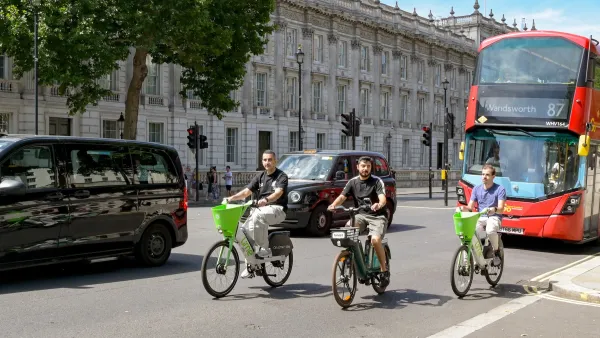
Bike use in London grew by 43% since 2019, but car use remains roughly the same
The city's efforts to reduce car use have stalled despite ambitious programs like congestion pricing and low-traffic neighborhoods.

Beavers save London Tube station from flooding
A small group of beavers is increasing biodiversity and creating cost-free flood mitigation infrastructure.
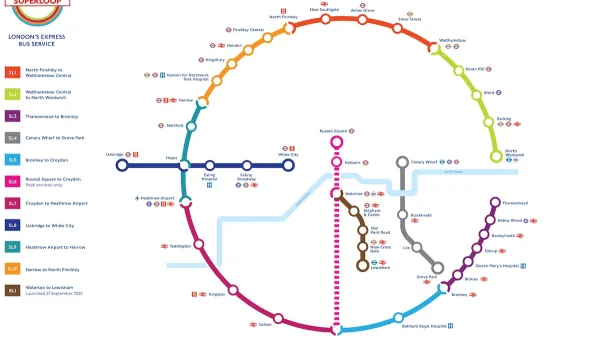
London’s Superloop BRT Ridership Grows by 20% While Other Bus Ridership Declines
The new rapid bus system launched its first suburban line, the first of 10 that will extend outside central London.

Planetizen Federal Action Tracker
A weekly monitor of how Trump’s orders and actions are impacting planners and planning in America.

Eastern Nebraska is running out of electricity
Data centers and electrification are straining eastern Nebraska’s grid, throttling economic development.

Study reveals best places in the U.S. for cycling, walking
New research from Streetlight Data examines bicycle and pedestrian miles per capita in the 100 largest U.S. cities by population.

DSA members accuse Mamdani of 'abandoning values' over housing redevelopment
New York City's mayor plans to replace about 2,000 units of public housing with private, mixed-income housing.

All sides of BRT debate unhappy with CDOT’s most recent move
The Colorado Department of Transportation is no longer considering center-running bus lanes for Colorado Boulevard.

Massachusetts bogs generate both power, and cranberries
Putting solar panels above farmland is one way Massachusetts is advancing toward its goal of net-zero carbon emissions by 2050.

FREE Course: Walkable City 1: Why Walkability?
After describing his path towards focusing on walkability as the essence of good planning, Jeff Speck marches through his five principal reasons for making more walkable places.
Reinventing Malls: Planning Alchemy—Turning Gray Fields Into Gold
The course focuses on the opportunities and imperatives that shape reinvention of mall sites.

City of Rosemead
Rutgers University, Edward J. Bloustein School of Planning and Public Policy
One Hundred Miles
University of Michigan School for Environment and Sustainability (SEAS)
Hunter College, City University of New York (CUNY)
The Architects Foundation
City of Cambridge
The Pocatello Development Authority
The Urban Renewal Agency of the City of Pocatello