Whatever Atlanta area voters decide when they head to the polls tomorrow to vote on a proposed 10-year, 1 percent sales tax to fund transit and road projects, the outcome will be a historic moment in the area's history. Ariel Hart puts it in context.


In case you haven't been paying attention, voters in 10 counties in the metropolitan Atlanta region will vote tomorrow on a transportation sales tax referendum - referred to as T-SPLOST - that would raise $6.14 billion over a decade for regional transportation projects and another $1 billion for smaller, local projects.
With advocates calling the referendum "an Olympic moment" for the region and opponents calling it "a potential mistake of historic proportions," Hart calls the vote "Atlanta's next historic move" and argues that "[n]ot many decisions in Atlanta's past carry more weight."
With recent polls suggesting the referendum will fail, Hart takes a look at some other notably divisive initiatives that have changed the trajectory of the city.
Read the full story: T-SPLOST vote: Another historic move for Atlanta
Can Atlanta Solve Its Transit Problems by Taxing Parking?
In the aftermath of the disappointing defeat of a one-cent regional sales tax transportation measure, the city council is considering two measures to raise transportation revenue, one being a parking tax based on a Georgia Tech masters thesis.
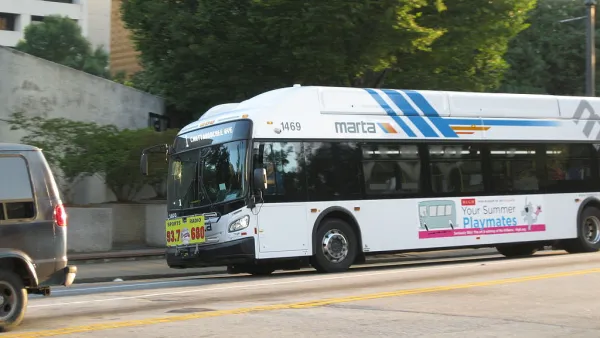
Light Rail Plans Could Become Bus Rapid Transit Plans in Atlanta
Light rail on the Clifton Corridor was once a centerpiece of a $2.7 billion, 40-year transit expansion plans funded by a voter-approved sales tax. Now MARTA is considering using bus rapid transit on the corridor instead.
Atlanta to Use Transportation Sales Tax Money on Park Expansion
Transportation tax funding has suddenly been diverted to a park project in Atlanta, and a few voices want to know why. The project still gained approval, however.

Planetizen Federal Action Tracker
A weekly monitor of how Trump’s orders and actions are impacting planners and planning in America.

California plans to bury El Niño’s downpour
If the state plays its cards right, it may be able to store a billion acre-feet of El Niño’s water in aquifers.

Desperate measures: Advocates weigh draining Lake Powell to fill Colorado River
Draining the reservoir could reduce evaporation losses by a couple hundred thousand acre-feet.

Mamdani’s pied-à-terre tax survives legal challenge
A panel of judges found that the plaintiffs failed to demonstrate injury as a result of New York City's implementation of the tax.

Eastern Nebraska is running out of electricity
Data centers and electrification are straining eastern Nebraska’s grid, throttling economic development.

Seattle passes record-breaking transit services expansion
Proposition 1 will double the city’s transit tax to add 95,000 more bus trips and preserve 180,000 bus trips annually.

FREE Course: Walkable City 1: Why Walkability?
After describing his path towards focusing on walkability as the essence of good planning, Jeff Speck marches through his five principal reasons for making more walkable places.
Reinventing Malls: Planning Alchemy—Turning Gray Fields Into Gold
The course focuses on the opportunities and imperatives that shape reinvention of mall sites.

City of Rosemead
Rutgers University, Edward J. Bloustein School of Planning and Public Policy
One Hundred Miles
University of Michigan School for Environment and Sustainability (SEAS)
Hunter College, City University of New York (CUNY)
The Architects Foundation
City of Cambridge
Montrose County
The Pocatello Development Authority