Many new light rail lines have been built in western cities in the hopes of attracting new development to greenfields. Los Angeles' Expo Line, however, is threaded through a heavily built-up area, thus complicating dreams of TOD.


"Built on a former trolley right-of-way, the Expo Line connects downtown Los Angeles with the Westside via rail for the first time in decades. Whereas Los Angeles' old Pacific Electric Railway had been built in virgin territory in order to spur new development, the Expo Line is but a filament, woven into built-up neighborhoods. Expo-adjacent neighborhoods are no streetcar suburbs, however. Now that the Westside once again has the "T," efforts to figure out the "OD" have only just begun,", writes Josh Stephens.
Thanks to Josh Stephens
Read the full story: New Light Rail Line Opens Up World of TOD Possibilities
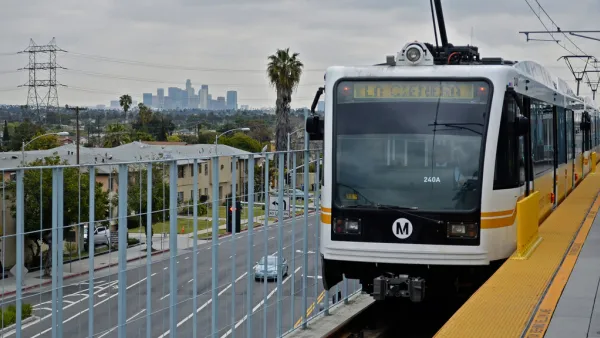
New Bike and Bus Lanes Coming to Culver City, California
The MOVE Culver City project will connect downtown Culver City with the E Line train, giving residents easier access to downtown Los Angeles and beach communities.
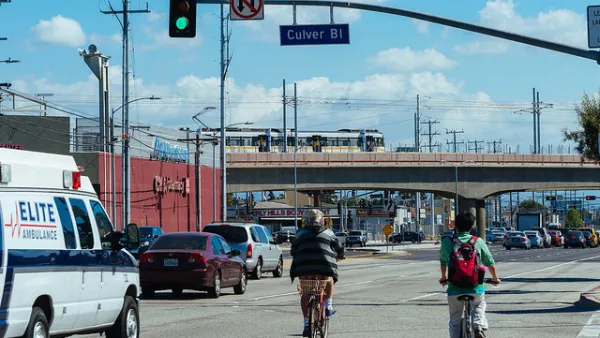
Designing a Multi-Modal, User-Focused TOD Vision for Los Angeles' Expo Line
Facing explosive development interest around its Metro station, the small city of Culver on L.A.’s Westside is taking steps to shape its mobility future.
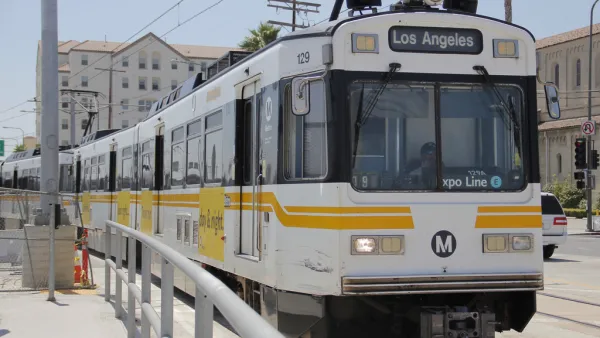
L.A.'s Complicated Dance Between TOD and Displacement
As the Los Angeles metro area expands its transit options, transit-oriented development is following suit. In some neighborhoods, lower-income residents are being displaced.

Planetizen Federal Action Tracker
A weekly monitor of how Trump’s orders and actions are impacting planners and planning in America.

California plans to bury El Niño’s downpour
If the state plays its cards right, it may be able to store a billion acre-feet of El Niño’s water in aquifers.

Desperate measures: Advocates weigh draining Lake Powell to fill Colorado River
Draining the reservoir could reduce evaporation losses by a couple hundred thousand acre-feet.

Mamdani’s pied-à-terre tax survives legal challenge
A panel of judges found that the plaintiffs failed to demonstrate injury as a result of New York City's implementation of the tax.

Eastern Nebraska is running out of electricity
Data centers and electrification are straining eastern Nebraska’s grid, throttling economic development.

Seattle passes record-breaking transit services expansion
Proposition 1 will double the city’s transit tax to add 95,000 more bus trips and preserve 180,000 bus trips annually.

FREE Course: Walkable City 1: Why Walkability?
After describing his path towards focusing on walkability as the essence of good planning, Jeff Speck marches through his five principal reasons for making more walkable places.
Reinventing Malls: Planning Alchemy—Turning Gray Fields Into Gold
The course focuses on the opportunities and imperatives that shape reinvention of mall sites.

City of Rosemead
Rutgers University, Edward J. Bloustein School of Planning and Public Policy
One Hundred Miles
University of Michigan School for Environment and Sustainability (SEAS)
Hunter College, City University of New York (CUNY)
The Architects Foundation
City of Cambridge
Montrose County
The Pocatello Development Authority