When he took office last year, Rahm Emmanuel inherited a city in which a sheen of new projects hid a crumbling infrastructure. With a laundry list of initiatives, the mayor is intent on retaining the city's place amongst the world's great cities.


The capital of the Midwest for over a century, Chicago has been showing signs of its age for decades now. A much-needed face-lift is in order. Fortunately, Mayor Rahm Emmanuel has made modernizing the city a priority. As Ed Pilkington of The Guardian reports, "[o]ver the next three years Emanuel will pump $7bn to bring the ageing city up to scratch."
The mayor's list of improvements include, "a massive upgrading of the underground water infrastructure, two new runways at O'Hare airport, an overhaul of subway stations, $660m investment in public schools, a rapid-transit bus system in the centre of the city and the first steps towards making Chicago the most bike-friendly city in the world." Perhaps most interesting is the plan to make all of downtown Chicago completely wireless, giving the city, already as the "broadband backbone of America..., a huge strategic advantage."
As cities increasingly face international competition, Emmanuel centers much of his ambition on rejuvenating what he calls "the most American of American cities."
"Should Emanuel succeed in implementing even a portion of his ambitions," writes Pilkington, "he will have written himself into the history books as one of a new generation of activist mayors grabbing American cities by the lapels and giving them a good shake."
Read the full story: Chicago to get hyper-connected under Rahm Emanuel's grand Wi-Fi plan
Get Around Chicago Like an Insider with 20 Apps
These 20 apps and services will help you engage with everything Chicago has to offer in a whole new way.
TIF Trouble in Chicago
Aaron Renn asserts that Chicago mayor Rahm Emmanuel's misuse of tax-increment financing dollars is hurting the city's poor.
Rahm Emanuel Expands Chicago's Commitment to Bike-Centric Development
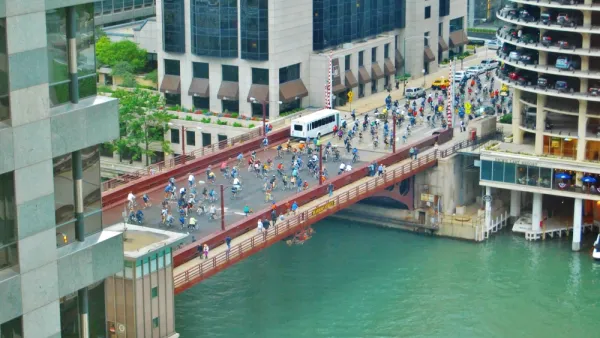
Chicago's flat topography makes it ideal for bike riding. Now Rahm Emanuel and Gabe Klein's new public policies aim to grow their use. The city consistently scores as highly in bike-friendly rankings as New York, Austin, or Denver.

Desperate measures: Advocates weigh draining Lake Powell to fill Colorado River
Draining the reservoir could reduce evaporation losses by a couple hundred thousand acre-feet.

Eastern Nebraska is running out of electricity
Data centers and electrification are straining eastern Nebraska’s grid, throttling economic development.

Malls are becoming the midtowns of the future
Mall and office park redevelopments are a generational opportunity to create new nodes of urbanity.

NYC breaks ground on anti-flooding infrastructure project
New York City's new system will reduce stormwater flows to local sewers by 90%.

One Kentucky town’s secret to affordable housing
The Smoketown Community Land Trust has already built seven affordable homes for community members.

Houston gains petal-shaped cooling infrastructure to make streets more ‘delightful’
The city has installed the pavilions along 15 blocks in Houston.

FREE Course: Walkable City 1: Why Walkability?
After describing his path towards focusing on walkability as the essence of good planning, Jeff Speck marches through his five principal reasons for making more walkable places.
Reinventing Malls: Planning Alchemy—Turning Gray Fields Into Gold
The course focuses on the opportunities and imperatives that shape reinvention of mall sites.

City of Rosemead
Rutgers University, Edward J. Bloustein School of Planning and Public Policy
One Hundred Miles
University of Michigan School for Environment and Sustainability (SEAS)
Hunter College, City University of New York (CUNY)
The Architects Foundation
City of Cambridge
Montrose County
The Pocatello Development Authority