Lloyd Alter investigates the individuals and organizations "manufacturing" the anti-Agenda 21 campaign, and argues that "Big Oil" is helping to bankroll anti-sustainability efforts.


Although the anti-Agenda 21 rhetoric has made waves in the media, and in state and local governments across America, Robin Rather of Collective Strength,
who commissioned a recent survey for the APA that showed the majority of Americans don't know enough about it and only 6% oppose it, believes "the Agenda 21
phenomenon is highly manufactured. It's not out there in the
mainstream."
So who is responsible for leading the charge? Alter points to organizations such as the John Birch Society, American Policy Center, Americans for Prosperity, and Freedom Advocates as directing the Agenda 21 conspiracy campaign.
For Alter, it is, "clear that the anti-agenda 21, anti-sustainability movement
is punching way above its weight in terms of public awareness and
support. It's not a grass roots movement of concerned local activists,
but, as Robin Rather puts it, 'a brilliant campaign, preying on real
fears that people have' about their homes and property."
Read the full story: Exposing the Influence Behind the Anti-Agenda 21 Anti-Sustainability Agenda

Tea Partiers Try to Halt Indy Transit Vote
As the Indiana Senate begins to consider whether to allow residents to vote on a tax referendum to expand mass transit in Central Indiana, Tea Party-aligned groups are trying to derail the legislation.
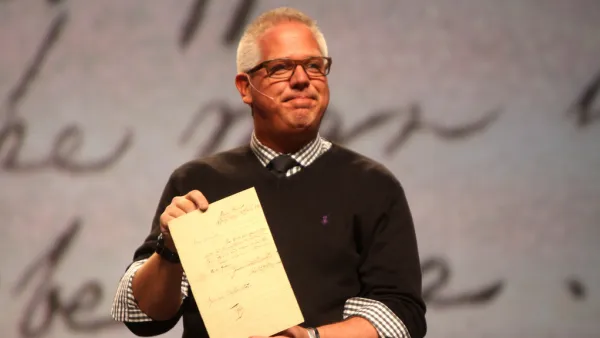
Glenn Beck Plans His Ideal City
The conservative commentator has proposed a $2 billion "city-theme park hybrid" that "would bring several of Glenn’s seemingly disconnected projects into one place." You'll be surprised at the similarities with certain Smart Growth principles.

Are Planners the Victims of a Dastardly Mind-Control Plot?
If you've ever led a public planning process you may be complicit in perpetuating a diabolical conspiracy to coerce Americans into accepting "a United Nations-run communist dictatorship in which suburbanites will be forcibly relocated to cities."

Planetizen Federal Action Tracker
A weekly monitor of how Trump’s orders and actions are impacting planners and planning in America.

Amtrak, CN end decades-long dispute with eight-year agreement
The new operating agreement establishes an updated framework for the companies to work together, including processes to resolve disputes.

Judges permit Denver to divert 77,000 acre feet from the Colorado River for reservoir expansion
Overuse and climate change have caused the Colorado River’s water levels to plummet.

Boston has spent millions making the Green Line more accessible — and there’s no end in sight
While the city has invested millions into expanding and adding platforms to the Green Line to make it more accessible, new train cars set to arrive next year will be too tall for disabled passengers to board without raising the current platforms.

Idaho may see an 18% drop in federal surface transit funding — the largest estimated cut in the US
Transit systems in rural communities are much more reliant on federal funding to provide their services.

How ‘post-disaster gentrification’ alters neighborhoods after natural calamities
After hurricanes, fires or other calamities, the original residents of a community are often replaced by younger, wealthier residents.

FREE Course: Walkable City 1: Why Walkability?
After describing his path towards focusing on walkability as the essence of good planning, Jeff Speck marches through his five principal reasons for making more walkable places.
Reinventing Malls: Planning Alchemy—Turning Gray Fields Into Gold
The course focuses on the opportunities and imperatives that shape reinvention of mall sites.

City of Wisconsin Rapids
Harvard University Graduate School of Design
KFH Group Inc.
The Architects Foundation
University of Cincinnati Online
The Pocatello Development Authority
The Urban Renewal Agency of the City of Pocatello