A bill in California that would reduce parking minimums in transit-oriented areas has drawn opposition from an unlikely group: the American Planning Association.


"Ever since the 2005 publication of UCLA professor Don Shoup's book, The High Cost of Free Parking, the relaxation of parking minimums has been seen by many planners as the next best thing to manufacturing new land. Yet, the introduction of a bill that would enact a modest page from the Shoup playbook has roused opposition from a surprising source: the American Planning Association," writes Josh Stephens.
"'The primary issue is that it's a one-size fits all statewide standard," said APA California Vice President for Policy and Legislation David Snow. "While APA supports the concept that this bill puts forward .from APA's perspective, a uniform standard from the state that doesn't take into account local considerations isn't the appropriate way forward.'"
APA California also contends that, by imposing lower parking requirements, cities would be less inclined to support transit and to support higher, denser infill development. APA California acknowledges that many cities want to "grow up and not out" and calls such a strategy "responsible." In that sense, the APA and Infill Builders Association would typically be considered natural allies.
Streetsblog Los Angeles has reprinted a letter authored by Shoup himself discussing, "his reasoning for supporting the bill and displeasure that the Cal APA would oppose the bill without consulting its membership."
Thanks to Josh Stephens
Read the full story: Resurrected Parking Bill Draws Fire from APA
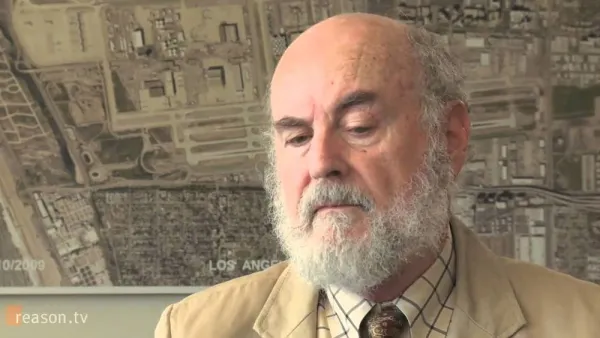
Legendary Parking Guru Donald Shoup Dies at 86
Urbanists are mourning the loss of a dynamic voice for parking reform and walkable cities.

Ann Arbor Votes to Eliminate Parking Minimums
Ann Arbor, Michigan approved changes to the city’s Unified Development Code (UDC) earlier this week that eliminate off-street parking requirements for a variety of development types throughout the city.

Oregon to Reform Parking Requirements in 52 Cities
Oregon, the first state to end single-family zoning statewide, is on the cusp of another historic planning reform as the Land Conservation and Development Commission nears approval for new “Climate-Friendly and Equitable Communities” rules.

Planetizen Federal Action Tracker
A weekly monitor of how Trump’s orders and actions are impacting planners and planning in America.

Eastern Nebraska is running out of electricity
Data centers and electrification are straining eastern Nebraska’s grid, throttling economic development.

Study reveals best places in the U.S. for cycling, walking
New research from Streetlight Data examines bicycle and pedestrian miles per capita in the 100 largest U.S. cities by population.

DSA members accuse Mamdani of 'abandoning values' over housing redevelopment
New York City's mayor plans to replace about 2,000 units of public housing with private, mixed-income housing.

All sides of BRT debate unhappy with CDOT’s most recent move
The Colorado Department of Transportation is no longer considering center-running bus lanes for Colorado Boulevard.

Massachusetts bogs generate both power, and cranberries
Putting solar panels above farmland is one way Massachusetts is advancing toward its goal of net-zero carbon emissions by 2050.

FREE Course: Walkable City 1: Why Walkability?
After describing his path towards focusing on walkability as the essence of good planning, Jeff Speck marches through his five principal reasons for making more walkable places.
Reinventing Malls: Planning Alchemy—Turning Gray Fields Into Gold
The course focuses on the opportunities and imperatives that shape reinvention of mall sites.

City of Rosemead
Rutgers University, Edward J. Bloustein School of Planning and Public Policy
One Hundred Miles
University of Michigan School for Environment and Sustainability (SEAS)
Hunter College, City University of New York (CUNY)
The Architects Foundation
City of Cambridge
The Pocatello Development Authority
The Urban Renewal Agency of the City of Pocatello