With several sporting events of national notice taking place in downtown Los Angeles, last weekend provided a prime platform to showcase the resurgence of the area. However, big-ticket events are just one of the many forces re-energizing downtown.


L.A. Live, the sports and entertainment mega-complex that was the locus of excitement over last weekend, is just one of the forces of change that Sam Allen and Hector Becerra describe in their exploration of downtown Los Angeles's transformation.
"These big-ticket events tell only part of the story. Urban planners and others say that smaller, organic neighborhood forces, the inventive mix of retail shops, restaurants, bars and galleries, have also been an important draw."
"[Joel] Kotkin and others said downtown is really a collection of neighborhoods - not a monolithic whole - each with its own vibe. And they are much less interconnected than many might think."
"Downtown L.A. is like the rest of the city," said Steven Erie, a political science professor at UC San Diego who has written about Los Angeles. "Just like you have a spread-out city, you have nodes in downtown. They're very weakly connected, and that's the way L.A. grew, and that's the way downtown was developed. There's multiple downtown experiences."
Read the full story: Downtown L.A.'s many communities live, work, play side by side

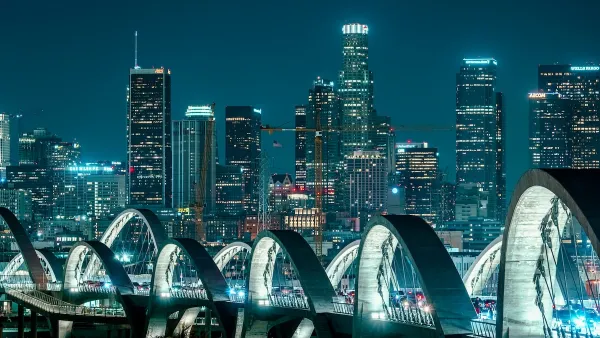
Downtown Los Angeles Gears Up for Growth
A new report highlights Downtown L.A.’s ongoing revival through major housing projects, adaptive reuse, hospitality growth, and preparations for global events in the years ahead.
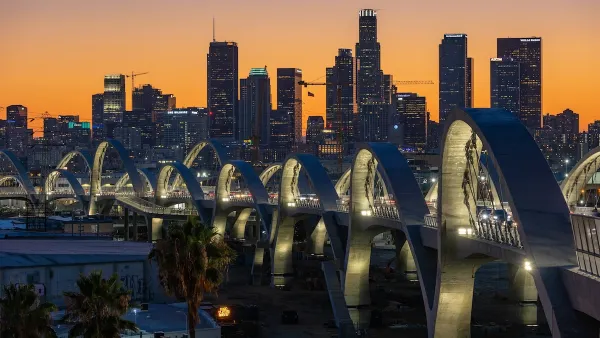
Downtown Los Angeles on the Rise: A Promising 2025
Fueled by new developments, cultural investments, and a growing dining scene, downtown Los Angeles is poised for significant growth in 2025, despite challenges from recent wildfires and economic uncertainties.
The Urban Shortcomings of 'L.A. Live'
L.A. Live, the city's new megadevelopment, does little to engage the growing downtown area and ends up being little more than another separate commercial enclave in a city desperately needing closely-knit urbanism, according to Christopher Hawthorne.

Planetizen Federal Action Tracker
A weekly monitor of how Trump’s orders and actions are impacting planners and planning in America.

‘Going backwards:’ Baltimore mayor, students rally against state's transit funding plan
Maryland's proposed six-year plan provides no funding for Baltimore’s BMORE bus program and reduces its road maintenance funding.

Detroit to transform waterfront with $2.2 billion investment
Developers will convert about 18 acres of unused parking lot space into civic spaces.

U.S.-Iran war may have ‘devastating’ impact on cost to warm homes
Vermont and Maine residents may see a 76% increase in the cost of warming their homes this winter.

Senate bill would ‘overhaul’ environmental permitting laws
Under the proposed act, government agencies would also not be able to suspend or rescind permits after granting them.

Exemption applications for NYC’s pied-à-terre tax see 55% success rate
The city sent nearly 40% of its initial pied-à-terre tax warnings erroneously.

FREE Course: Walkable City 1: Why Walkability?
After describing his path towards focusing on walkability as the essence of good planning, Jeff Speck marches through his five principal reasons for making more walkable places.
Reinventing Malls: Planning Alchemy—Turning Gray Fields Into Gold
The course focuses on the opportunities and imperatives that shape reinvention of mall sites.

One Hundred Miles
County of Mendocino
planning NEXT
The Architects Foundation
University of Cincinnati Online
Montrose County
Northern Illinois Transit Authority (NITA)
The Pocatello Development Authority