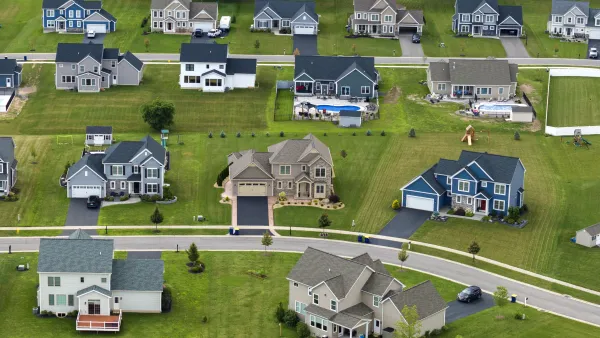
Haya El Nasser describes the housing market's fundamental structural changes as the housing industry rethinks what type of housing to build and where to build it.


The shift in tastes from suburban sprawl to compact urban amenities goes mainstream, as USA Today covers the historic shift in the nation's development patterns.
"Whether it's temporary or a seminal moment in the nation's development history, the housing bust and recession have prompted developers to set their sights inward. When property values drop, so does investment. And because values dropped the most on the outer edges of metro areas, developers are paying attention to sites they never considered before."
"Most major builders have created "urban" divisions in the past five years to scout for available land in already-developed parts of cities and closer suburbs - even if it means former industrial and commercial sites or land that may require environmental cleanup."
"This shift doesn't mean the end of sprawling suburban subdivisions in onetime cow pastures and corn fields, but it does signal a notable change that could alter the housing landscape for years to come."
Read the full story: Subdivisions go urban as housing market changes


Wildfires are coming for America’s suburbs
Buying land in between paved cities and forests has become increasingly popular, but those same areas are naturally fire prone.
Johns Hopkins updates their sprawl database
In a follow up to their 2014 study, Johns Hopkins has released new data on urban sprawl in the U.S. and new findings on its health and wellbeing impacts.

Cost of living too high? Planners to the rescue!
Excessive costs of living force many people to work more than optimal hours, leaving less time for family and fun. Local policies that favor affordable housing and transportation increase freedom, opportunity and happiness.

Planetizen Federal Action Tracker
A weekly monitor of how Trump’s orders and actions are impacting planners and planning in America.

The state-sanctioned urbicide of Austin
People don’t kill cities. Freeways do.

Colorado’s Largest Data Center Could Rise Next to Homes — Without a Public Hearing
The proposed campus would consume 11 times the power of Denver International Airport; as it has across the country, opposition mounts.

Judges permit Denver to divert 77,000 acre feet from the Colorado River for reservoir expansion
Overuse and climate change have caused the Colorado River’s water levels to plummet.

Amtrak, CN end decades-long dispute with eight-year agreement
The new operating agreement establishes an updated framework for the companies to work together, including processes to resolve disputes.

Raised interest rates may kill financially vulnerable construction projects
The chief economist at ConstructConnect warns that if construction project owners are negatively impacted by the raised rates, it could result in delayed payments to contractors.

FREE Course: Walkable City 1: Why Walkability?
After describing his path towards focusing on walkability as the essence of good planning, Jeff Speck marches through his five principal reasons for making more walkable places.
Reinventing Malls: Planning Alchemy—Turning Gray Fields Into Gold
The course focuses on the opportunities and imperatives that shape reinvention of mall sites.

KFH Group Inc.
Greater Baltimore Committee
Eagle County Government
The Architects Foundation
University of Cincinnati Online
The Pocatello Development Authority
The Urban Renewal Agency of the City of Pocatello