Yonah Freemark assesses one of the nation's most important public transportation improvement projects, LA's long discussed Westside Subway project which is closer than ever to construction, but still a long ways off from completion.


Advertised for decades as the "Subway to the Sea" as its prospects grew and dimmed repeatedly over time, LA's currently proposed Westside Subway project will actually terminate in Westwood, more than three miles from the Ocean. With the project having reached a key milestone with the recent release of the Final Environmental Impact Statement/Environmental Impact Report by Metro, the region's transportation authority, Freemark takes the opportunity to appraise its significance and unanswered questions.
According to Freemark, the project is one of the most practical and urgently needed transit improvement projects in the country. "It would offer an alternative option for tens of thousands of daily riders and speed travel times by up to 50% compared to existing transit trips. It would serve one of the nation's densest and most jobs-rich urban corridors and in doing so take a major step forward towards making L.A. a place where getting around without a car is comfortable."
While the proposed line's impact will be substantial, with estimated travel time savings more than almost any other transit project in the country, questions remain about the project's timeline and station location. In the article, Freemark explores the reasons for the generally unacceptable 25-year project timeline and for serious questions about station location, specifically at its terminus in "a pedestrian-hostile environment" at the Westwood/V.A. Hospital.
Read the full story: L.A.’s Westside Subway is Practically Ready for Construction, But Its Completion Could be 25 Years Off

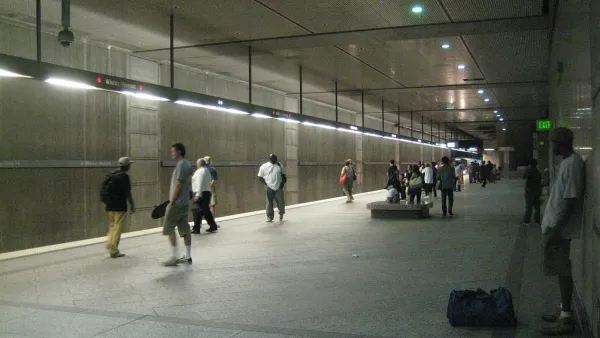
Purple Line Extension Gets $1.6 Billion Boost in Los Angeles
The Purple Line subway extension is picking up momentum in Los Angeles. With construction already underway on the first phase, the second phase should commence in 2018.
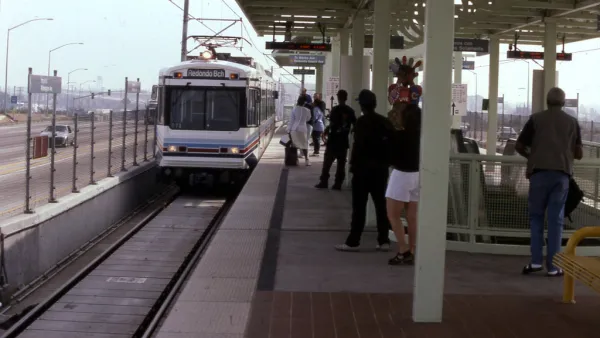
Targeting Another Gap in the System, L.A. Metro Looks to Expand Eastward
The potential 2.8 mile expansion of the Metro Green Line would connect light rail to the Norwalk MetroLink Station, opening up new transit options to users throughout the region.
San Fernando Valley Playing Catch Up in the Los Angeles Transit Boom
Dakota Smith reports that the Los Angeles transit renaissance is leaving the political leadership in the San Fernando Valley feeling left behind.

Planetizen Federal Action Tracker
A weekly monitor of how Trump’s orders and actions are impacting planners and planning in America.

California plans to bury El Niño’s downpour
If the state plays its cards right, it may be able to store a billion acre-feet of El Niño’s water in aquifers.

Chicago breaks ground on $3 billion megadevelopment
The new neighborhood, titled Foundry Park, will one day host 3,700 residences.

Desperate measures: Advocates weigh draining Lake Powell to fill Colorado River
Draining the reservoir could reduce evaporation losses by a couple hundred thousand acre-feet.

This road in NYC is infamously dangerous — and Mamdani can't fix it
New York City's Ocean Parkway is known for reckless driving, but the power to implement safety measures lies with the state rather than the city.

One of Denver’s busiest corridors to gain BRT
The project will span 18 miles and contain 74 bus rapid transit stations.

FREE Course: Walkable City 1: Why Walkability?
After describing his path towards focusing on walkability as the essence of good planning, Jeff Speck marches through his five principal reasons for making more walkable places.
Reinventing Malls: Planning Alchemy—Turning Gray Fields Into Gold
The course focuses on the opportunities and imperatives that shape reinvention of mall sites.

City of Rosemead
Rutgers University, Edward J. Bloustein School of Planning and Public Policy
One Hundred Miles
Hunter College, City University of New York (CUNY)
The Architects Foundation
University of Cincinnati Online
City of Cambridge
Montrose County
The Pocatello Development Authority