Judy Woodruff reports on the Department of Justice decision requiring government and private building owners to alleviate architectural barriers that prevent persons with disabilities from taking full advantage of facilities' amenities.


Though the Americans with Disabilities Act (ADA) has been in place for two decades, accessibility is an ongoing issue. The Department of Justice has indicated that all government and private building owners are required to ensure that there are no architectural barriers that prevent a person with a disability from fully utilizing the building. Based on a 2010 revision of federal guidelines, which extended the ADA to cover recreational facilities, the Justice Department mandate will extend beyond the building.
Of particular interest to the hospitality industry and municipalities will be the mandate to install wheelchair lifts in swimming pools. Two South Carolina Senators have already introduced a bill that would prevent the Attorney General from enforcing the rules covering swimming pools and the Hotel Association has asked the Justice Department for a delay in implementing the rules. The Justice Department remains strong on the issue, however, even if it means seeing closed pools as the summer months approach.
Thanks to Jessica Brent
FULL STORY: Two Hopeful Signs for Americans with Disabilities


Amtrak makes over 160 stations fully accessible
Upgrades include new elevators, signage and accessible restrooms.

Look North: 3 ways Canadian planners are crushing digital accessibility
Although accessibility regulations look similar in the United States and Canada, our northern neighbors have managed to make planning materials more usable for people with disabilities. Here's what we can learn from them.
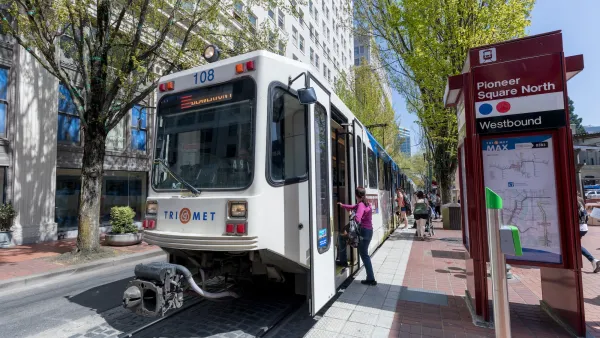
TriMet will eliminate 'Hand-to-Hand' paratransit service for half of its users
Roughly 300 Portland-area paratransit riders will lose access to a program that lets drivers escort them into their destination.

Planetizen Federal Action Tracker
A weekly monitor of how Trump’s orders and actions are impacting planners and planning in America.

The state-sanctioned urbicide of Austin
People don’t kill cities. Freeways do.

US to reduce Colorado River water deliveries to Mexico
A new Colorado Treaty amendment reduces Mexico’s Colorado River water allocation by 250,000 acre feet.

5 New England states march closer to 800 megawatt wind energy project
Securing federal approval for the project may be complicated under the Trump administration, which has historically been hostile towards domestic wind power.

Baltimore to break ground on $50 million Transit Priority Project
The project will bring faster bus trips, safer streets and better bike connections to Baltimore.

Airbnb launches $250 million 'last-dollar financing' housing accelerator, makes first investment in Austin
The company will put $6.4 million towards affordable housing development in Texas’ capital.

FREE Course: Walkable City 1: Why Walkability?
After describing his path towards focusing on walkability as the essence of good planning, Jeff Speck marches through his five principal reasons for making more walkable places.
Reinventing Malls: Planning Alchemy—Turning Gray Fields Into Gold
The course focuses on the opportunities and imperatives that shape reinvention of mall sites.

Eagle County Government
Harvard University Graduate School of Design
Nashville Planning Department
The Architects Foundation
University of Cincinnati Online
The Pocatello Development Authority
The Urban Renewal Agency of the City of Pocatello
Journal of the American Planning Association