After years of lost revenue from fare evaders, the Los Angeles County Metropolitan Transportation Authority (Metro) is looking to implement gate-locking at Metro rail stations within six months, reports Ari Bloomekatz.


For decades, Metro has trusted Los Angeles area passengers to abide by the honor system when paying for transit tickets. But, citing at least $4 million in revenue lost each year due to fare evasion on just one subway line alone, county supervisor and Metro board member Zev Yaroslavsky is asking the agency to look at ways to lock its gates.
According to Bloomekatz, "Yaroslavsky said one reason Metro officials failed to lock the gates sooner is because they were operating under the false assumption that only 3% of riders were evading fares. 'It's impossible that in a system where there's, practically speaking, no checking whether people paid their fare or not, that 97% would pay their fare,' Yaroslavsky said.
"The Metro staff tested locking gates at 10 stations last fall and winter and reported increased revenue at the 7th Street/Metro Center and North Hollywood stations by 18% to 22%."
Read the full story: Metro pushes again for lockdown on fare evaders
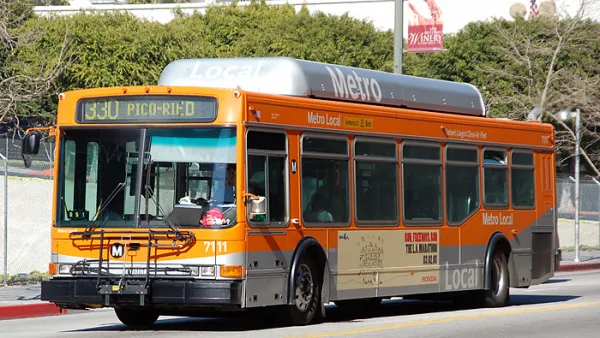
Transit Needs Improvements Sooner Rather Than Later
The Los Angeles transit system is losing riders, but L.A. Metro has been slow to implement changes that could keep people using it.
Many Lives, One Space on an L.A. Bus
A reporter rides the bus in Los Angeles and discovers the interesting, complicated, and sometimes heartbreaking stories that riders bring on board.
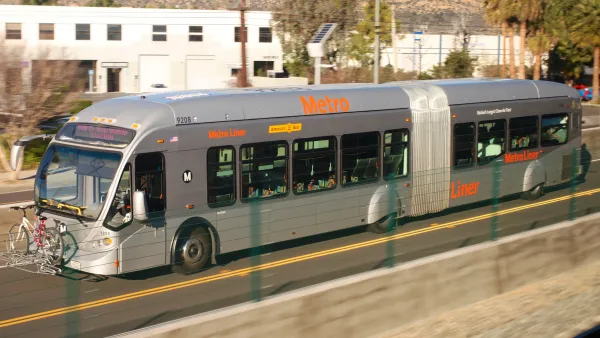
Thinking Outside of the Transit Box in L.A.
Metro is analyzing new geolocational data to look beyond conventional understandings of travel behavior.

Desperate measures: Advocates weigh draining Lake Powell to fill Colorado River
Draining the reservoir could reduce evaporation losses by a couple hundred thousand acre-feet.

Eastern Nebraska is running out of electricity
Data centers and electrification are straining eastern Nebraska’s grid, throttling economic development.

Move over, LA: St. Louis gears up for Olympics, invests millions in downtown redevelopment
The Missouri city will host the 2028 Olympic soccer group stage and knockout matches.

‘No clear next steps’ for Chicago's permanent festival grounds
Eleventh Ward Ald. Nicole Lee has suggested Soldier Field as a possible location for the permanent event space.

California, Hawaii, Rhode Island approve housing propositions
Hawaii and Rhode Island each approved their sole proposition, while California approved two of its three.

Officials claim feds 'rushed' Amtrak environmental review
Amtrak plans to move their Chicago maintenance facility from an industrial area to a residential one.

FREE Course: Walkable City 1: Why Walkability?
After describing his path towards focusing on walkability as the essence of good planning, Jeff Speck marches through his five principal reasons for making more walkable places.
Reinventing Malls: Planning Alchemy—Turning Gray Fields Into Gold
The course focuses on the opportunities and imperatives that shape reinvention of mall sites.

City of Rosemead
Rutgers University, Edward J. Bloustein School of Planning and Public Policy
One Hundred Miles
University of Michigan School for Environment and Sustainability (SEAS)
Hunter College, City University of New York (CUNY)
The Architects Foundation
City of Cambridge
Montrose County
The Pocatello Development Authority