Recent liberalization of the country's property ownership rules by President Raul Castro have unleashed decades of pent-up demand for real estate and construction in Cuba, reports Victoria Burnett.


The relaxing of property ownership and construction regulations are seen as an attempt to get capital flowing, according to Burnett. "During the past two months the state has reduced paperwork, stocked construction stores, legalized private contractors and begun offering homeowners subsidies and credits."
And residents are jumping on the opportunity to renovate and invest in properties. One result, according to Burnett, is that "Many sellers plan to downsize, so they can live better or leave.
"Victoria Pérez, a retired doctor, put her spacious house and two-bedroom annex on sale last month for $80,000. She hopes to buy something smaller and put aside about $20,000 to live on and visit her daughter in the United States. 'To earn $20,000 would take 20 years,' she said. 'This opens up a whole world of opportunities.'"
Read the full story: Cuba Unleashes the Pent-Up Energy of Real Estate Dreams


'This is going to be painful:’ Virginia stares down $1.7 billion funding gap for highway maintenance
The state may address the deficit by shifting $290 million from its construction budget to maintenance projects.
Raised interest rates may kill financially vulnerable construction projects
The chief economist at ConstructConnect warns that if construction project owners are negatively impacted by the raised rates, it could result in delayed payments to contractors.
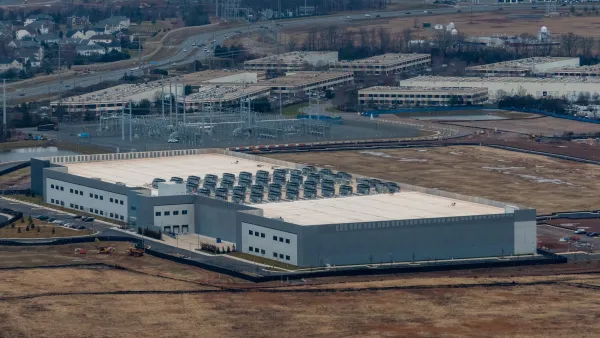
Data center developer offers over $4M per acre to buy out homeowners
Data center builders are outbidding home builders for land, prompting concerns about competition with housing.

Planetizen Federal Action Tracker
A weekly monitor of how Trump’s orders and actions are impacting planners and planning in America.

Amtrak, CN end decades-long dispute with eight-year agreement
The new operating agreement establishes an updated framework for the companies to work together, including processes to resolve disputes.

Judges permit Denver to divert 77,000 acre feet from the Colorado River for reservoir expansion
Overuse and climate change have caused the Colorado River’s water levels to plummet.

NYC DOT wants faster, more permanent street upgrades
The city is examining ways to build more concrete infrastructure without getting entangled in 'decades-long' projects.

'Something we’ve never seen before:' rising utility rates could strain city finances nationwide
Data centers, climate change and other factors have caused utility rates in the United States to increase by 38% since 2020.

Trump to overrule local leaders, lease millions of acres of America’s Pacific Island territories’ seafloors to mining companies
International law says that the Indigenous people of America’s territories have a right to prior and informed consent regarding projects that impact their countries.

FREE Course: Walkable City 1: Why Walkability?
After describing his path towards focusing on walkability as the essence of good planning, Jeff Speck marches through his five principal reasons for making more walkable places.
Reinventing Malls: Planning Alchemy—Turning Gray Fields Into Gold
The course focuses on the opportunities and imperatives that shape reinvention of mall sites.

Harvard University Graduate School of Design
KFH Group Inc.
Greater Baltimore Committee
The Architects Foundation
University of Cincinnati Online
The Pocatello Development Authority
The Urban Renewal Agency of the City of Pocatello