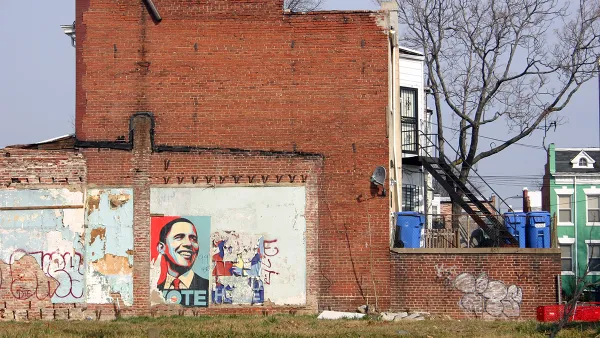
Writing in Grist, Greg Hanscom's position is that under Obama's guidance, the Federal Government has shifted away from subsidizing sprawl and towards reviving cities. Agree?


Although the Conference of Mayors might argue differently, Hanscom comes to the conclusion that, "Under President Obama, key federal agencies have begun to shift away from subsidizing suburban sprawl and toward reviving cities and creating dense, walkable, transit-friendly communities."
Hanscom points to the creation of the Special Assistant for Urban Affairs position, TIGER grant funding, the Neighborhood Stabilization Program, the Strong Cities, Strong Communities program, and the Sustainable Communities Initiative, to buttress his argument.
He cites the failure to pass a new transportation bill as Obama's major failing. "That's a lack of leadership coming out of White House," [Christopher] Leinberger, [President of Locus] says. "President Obama spent too much political capital on high-speed rail instead of looking at light rail, street cars, and the entire range of transportation alternatives."
Read the full story: President Obama and the forgotten urban agenda
Obama Order Creates the Council on Community Solutions
The Obama Administration recently offered a parting gesture toward better coordination between the federal government and local and regional municipalities.
Transportation and HUD Cuts Stake out Front Lines for Impending Budget Battle
The House Appropriations Subcommittee on Transportation and HUD has proposed drastic cuts to Community Development Block Grants and eliminating funding for the Partnership for Sustainable Communities and TIGER. The cuts presage coming budget battles.
Obama Launches Strong Cities, Strong Communities Initiative In 6 Cities
Six pilot cities are selected for the launch of a new federal, interagency initiative know as 'Strong Cities, Strong Communities': Fresno, New Orleans, Detroit, Cleveland, Memphis and Chester, PA.

Planetizen Federal Action Tracker
A weekly monitor of how Trump’s orders and actions are impacting planners and planning in America.

California plans to bury El Niño’s downpour
If the state plays its cards right, it may be able to store a billion acre-feet of El Niño’s water in aquifers.

Desperate measures: Advocates weigh draining Lake Powell to fill Colorado River
Draining the reservoir could reduce evaporation losses by a couple hundred thousand acre-feet.

Mamdani’s pied-à-terre tax survives legal challenge
A panel of judges found that the plaintiffs failed to demonstrate injury as a result of New York City's implementation of the tax.

Eastern Nebraska is running out of electricity
Data centers and electrification are straining eastern Nebraska’s grid, throttling economic development.

Seattle passes record-breaking transit services expansion
Proposition 1 will double the city’s transit tax to add 95,000 more bus trips and preserve 180,000 bus trips annually.

FREE Course: Walkable City 1: Why Walkability?
After describing his path towards focusing on walkability as the essence of good planning, Jeff Speck marches through his five principal reasons for making more walkable places.
Reinventing Malls: Planning Alchemy—Turning Gray Fields Into Gold
The course focuses on the opportunities and imperatives that shape reinvention of mall sites.

City of Rosemead
Rutgers University, Edward J. Bloustein School of Planning and Public Policy
One Hundred Miles
University of Michigan School for Environment and Sustainability (SEAS)
Hunter College, City University of New York (CUNY)
The Architects Foundation
City of Cambridge
Montrose County
The Pocatello Development Authority