The Noguchi museum in New York has asked four artists to take a crack at city planning by offering a new way of interpreting the construction of urban fabric. Martha Schwendener evaluates the results.


The artists' responses to their brief include the installation of 'drivable grass' along Manhattan's Broadway, proposed by Rirkrit Tiravanija as a subversive comment on property and sustainability. Mary Miss focused on four smokestacks that tower over the museum's neighborhood in Long Island City, offering a plan that would convert them into an 'eco-feedback center registering environmental changes that would be visible to the community.'
"The question, however, is whether these projects will make it out of the gallery and into the world. The stated goal of "Civic Action" is to "spark an ongoing dialogue" between the creative sector and the community," but similar efforts have failed in the past.
Schwendener considers the institutions as the major power brokers, and suggests they commit to supporting one artist for five or ten years rather than four teams for less than a year.
Read the full story: Policy, Painted Or Set In Stone

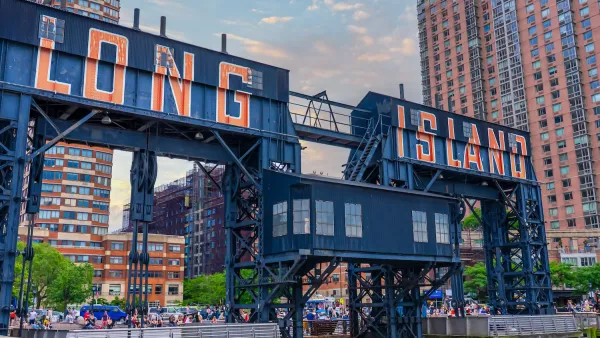
Upzoning Could Bring 15K New Homes to Queens
A rezoning plan for Long Island City opens up prime waterfront land for residential development, but some critics say new housing could be prone to flooding and should be built farther inland.
Where New Asian Residents Are Transforming New York City
Asians were the only major racial group in increase in population in all five boroughs of New York City since 2010. Long Island City in Queens saw a fivefold increase of Asian residents.
Measuring the Coronavirus Effect on Development in Brooklyn, Queens
Two development markets charged by an early 2000s rezoning will test the reach of the coronavirus in New York City's development market.

Planetizen Federal Action Tracker
A weekly monitor of how Trump’s orders and actions are impacting planners and planning in America.

California plans to bury El Niño’s downpour
If the state plays its cards right, it may be able to store a billion acre-feet of El Niño’s water in aquifers.

Chicago breaks ground on $3 billion megadevelopment
The new neighborhood, titled Foundry Park, will one day host 3,700 residences.

California High-Speed Rail Authority CEO resigns after $600,000 scandal
Under Ian Choudri, the authority used taxpayer dollars to fund first class flights and trips to nightclubs.

Want to study the Missouri River? Soon, you may need unanimous approval from 10 states
Legislation would require 10 governors’ permission to study or build projects moving water outside the basin.

Desperate measures: Advocates weigh draining Lake Powell to fill Colorado River
Draining the reservoir could reduce evaporation losses by a couple hundred thousand acre-feet.

FREE Course: Walkable City 1: Why Walkability?
After describing his path towards focusing on walkability as the essence of good planning, Jeff Speck marches through his five principal reasons for making more walkable places.
Reinventing Malls: Planning Alchemy—Turning Gray Fields Into Gold
The course focuses on the opportunities and imperatives that shape reinvention of mall sites.

City of Rosemead
Rutgers University, Edward J. Bloustein School of Planning and Public Policy
One Hundred Miles
Hunter College, City University of New York (CUNY)
The Architects Foundation
University of Cincinnati Online
City of Cambridge
Montrose County
The Pocatello Development Authority