British entrepreneur Roger Wade has built "[t]he most environmentally friendly shopping mall ever built." 'Boxpark,' which recently opened, is composed of 60 standard size shipping containers stacked two stories high by five rows wide.


George Webster, reporter for CNN, says that "despite the fact that the park does not boast sophisticated insulating technology or even a small array of solar panels, the simple fact that it's made from recycled materials adds credibility to Wade's claim."
For Wade, "the park represents a convenient alliance of economy and ecology, providing a cheap exciting retail space without extensive plundering of resources." Webster states that "recycled containers save 'embodied' carbon cost linked to construction of new buildings."
"The great thing is, if one of these shops doesn't feel it's getting the most out of this location, they can potentially move to another part of the country with a vacant bit of land, without having to close down or dismantle a thing," says Wade.
Built on a temporary site, Wade says that he'll return the land back to its owners in exactly the same condition as he got it, and then the community can decide if it wants a more permanent retail space there.
Read the full story: Crate expectations: Shipping containers used for first 'pop-up' shopping mall
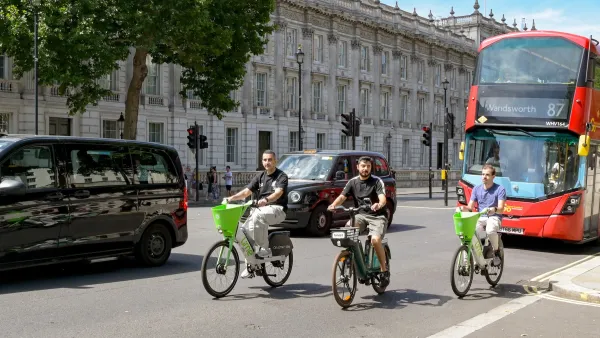
Bike use in London grew by 43% since 2019, but car use remains roughly the same
The city's efforts to reduce car use have stalled despite ambitious programs like congestion pricing and low-traffic neighborhoods.

Beavers save London Tube station from flooding
A small group of beavers is increasing biodiversity and creating cost-free flood mitigation infrastructure.
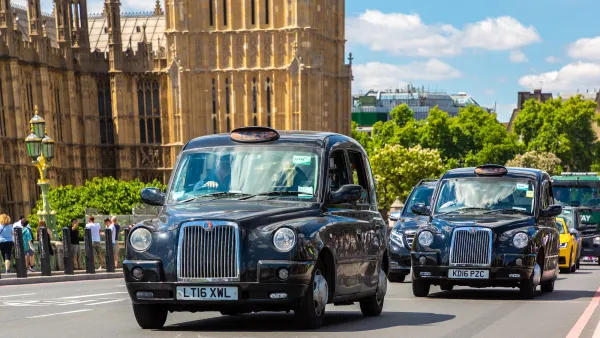
Can Robotaxis Handle London's Famously Tangled Streets?
Black Cab drivers say autonomous cars won’t be able to handle London’s unique conditions.

Planetizen Federal Action Tracker
A weekly monitor of how Trump’s orders and actions are impacting planners and planning in America.

Washington state to charge fee to drivers with fuel-efficient cars
Revenue from the fee will go towards supporting the state’s highways.

Trump to blast ‘hydrocarbon highway’ through ‘world’s longest art gallery’
Environmental and historic preservation groups are suing to stop the project.

Minnesota Gold Line extension now has launch date
Plans to extend the Gold Line have existed since 2025.

Data centers need power – lower income, rural residents pay the price
In 2025, data centers paid only 38% of the energy infrastructure costs linked to their growth, with households, especially rural and low-income residents, bearing the remaining burden.

MBTA Green Line project moved to next phrase of CIG program
The modernization effort will cost $4.08 billion.

FREE Course: Walkable City 1: Why Walkability?
After describing his path towards focusing on walkability as the essence of good planning, Jeff Speck marches through his five principal reasons for making more walkable places.
Reinventing Malls: Planning Alchemy—Turning Gray Fields Into Gold
The course focuses on the opportunities and imperatives that shape reinvention of mall sites.

City of Charlotte
City of Rosemead
Rutgers University, Edward J. Bloustein School of Planning and Public Policy
University of Michigan School for Environment and Sustainability (SEAS)
Hunter College, City University of New York (CUNY)
The Architects Foundation
University District Partnership