A new report from the Center for an Urban Future says that Manhattan's boroughs have been booming but transit hasn't caught up, leaving a lot of residents without access to jobs.


From the introduction to the report:
"Over the last two decades, the other four boroughs have been steadily growing their own vibrant job centers, in neighborhoods like Flushing, Queens, and East Flatbush, Brooklyn. Consequently, the number of commuters who travel to work in their own boroughs or to neighboring boroughs or counties has been growing much faster than the number of commuters who make the more traditional trip into Manhattan. For example, in the Bronx, the number of commuters traveling to Queens and Westchester County grew by 38 percent between 1990 and 2008, whereas the number going to Manhattan increased by just 13 percent in the same time period. Similarly lopsided numbers hold for Brooklyn, Queens and Staten Island.
If New York is going to retain a world-class public transportation system and sustain job growth outside of Manhattan, it must invest in solutions that make these less traditional commuter trips easier for passengers."
Read the full story: Behind the Curb
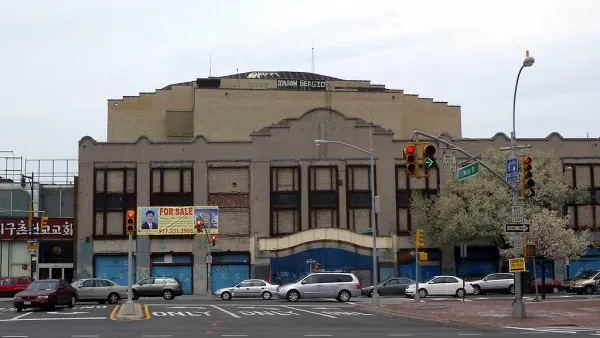
A Development Proposal 34 Years in the Making
Or a historic preservation fight, 34 years in the making, depending on your perspective.
Mayor de Blasio Stresses Affordable Housing in State of the City Address
In his State of the City Address on Feb. 3, the New York City mayor made it clear that his overriding priority is affordable housing. He targeted six neighborhoods in all five boroughs where development will be required to include affordable housing.
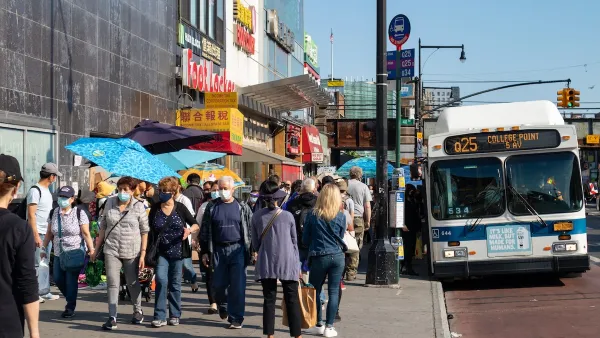
NYC bus network redesign speeds up Queens buses
Rush routes have seen a 4.6% speed increase after the redesign.

Planetizen Federal Action Tracker
A weekly monitor of how Trump’s orders and actions are impacting planners and planning in America.

California plans to bury El Niño’s downpour
If the state plays its cards right, it may be able to store a billion acre-feet of El Niño’s water in aquifers.

Desperate measures: Advocates weigh draining Lake Powell to fill Colorado River
Draining the reservoir could reduce evaporation losses by a couple hundred thousand acre-feet.

Los Angeles just elected an urban planner as its mayor
Transportation analysts are optimistic that Raman will be more aggressive in addressing transit issues than Bass.

Mamdani’s pied-à-terre tax survives legal challenge
A panel of judges found that the plaintiffs failed to demonstrate injury as a result of New York City's implementation of the tax.

Eastern Nebraska is running out of electricity
Data centers and electrification are straining eastern Nebraska’s grid, throttling economic development.

FREE Course: Walkable City 1: Why Walkability?
After describing his path towards focusing on walkability as the essence of good planning, Jeff Speck marches through his five principal reasons for making more walkable places.
Reinventing Malls: Planning Alchemy—Turning Gray Fields Into Gold
The course focuses on the opportunities and imperatives that shape reinvention of mall sites.

City of Rosemead
Rutgers University, Edward J. Bloustein School of Planning and Public Policy
One Hundred Miles
University of Michigan School for Environment and Sustainability (SEAS)
Hunter College, City University of New York (CUNY)
The Architects Foundation
City of Cambridge
Montrose County
The Pocatello Development Authority