For Washington D.C., ASLA polled members to develop a new "comprehensive framework" connecting sustainability with economic development.


The members who were polled are from the Potomac, Northern Virginia, and Southern Maryland chapters of the ASLA. The recommendations will be reviewed by various D.C. agencies, but among them:
Energy: "Washington, D.C. should undertake a comprehensive survey of existing brownfield sites to determine which could be used to form a public/private partnership with a solar power firm."
Water: "Set clear, ambitious targets and deadlines for reducing stormwater runoff in the District and measure progress against targets. Like New York City and Philadelphia, develop a robust green infrastructure action plan that leverages existing grey infrastructure systems. Enact green infrastructure rules that enable the use of fines for private properties that don't store their own runoff."
Transportation: As one ASLA member wrote, "Please incorporate bike lanes where the cyclists are protected by parked cars, as opposed to the parked cars being protected by the cyclists."
Read the full story: Becoming Greenest: Recommendations for a More Sustainable Washington D.C.
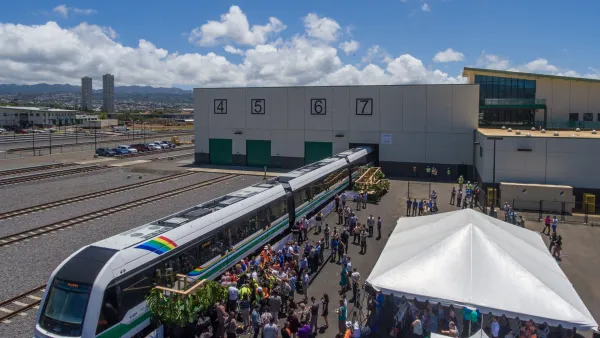
From robotaxis to robotrains: LA, DC weigh driverless transit
If approved, the projects will take years to implement and face financial and technical hurdles.
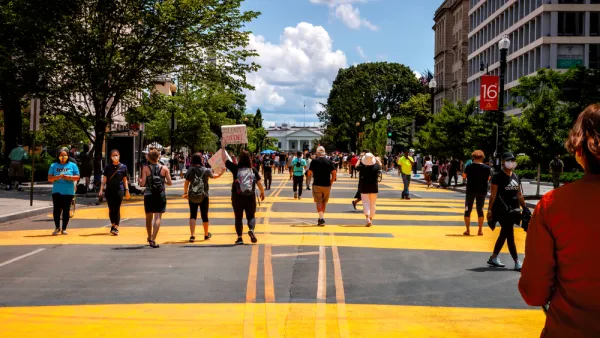
D.C. Revamps its Vision Zero Plan to Eliminate Traffic Fatalities
Washington, D.C. was an early adopter of Vision Zero in the United States, but eventually it became emblematic of the country's lack of progress in reducing traffic collisions.
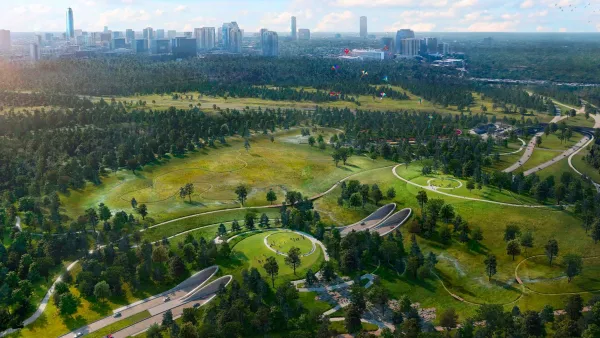
ASLA Commits to Profession-Wide Climate Action
The American Society of Landscape Architects has assembled a task force to create an action plan focused on climate change and biodiversity.

Planetizen Federal Action Tracker
A weekly monitor of how Trump’s orders and actions are impacting planners and planning in America.

California plans to bury El Niño’s downpour
If the state plays its cards right, it may be able to store a billion acre-feet of El Niño’s water in aquifers.

Desperate measures: Advocates weigh draining Lake Powell to fill Colorado River
Draining the reservoir could reduce evaporation losses by a couple hundred thousand acre-feet.

Mamdani’s pied-à-terre tax survives legal challenge
A panel of judges found that the plaintiffs failed to demonstrate injury as a result of New York City's implementation of the tax.

Eastern Nebraska is running out of electricity
Data centers and electrification are straining eastern Nebraska’s grid, throttling economic development.

Seattle passes record-breaking transit services expansion
Proposition 1 will double the city’s transit tax to add 95,000 more bus trips and preserve 180,000 bus trips annually.

FREE Course: Walkable City 1: Why Walkability?
After describing his path towards focusing on walkability as the essence of good planning, Jeff Speck marches through his five principal reasons for making more walkable places.
Reinventing Malls: Planning Alchemy—Turning Gray Fields Into Gold
The course focuses on the opportunities and imperatives that shape reinvention of mall sites.

City of Rosemead
Rutgers University, Edward J. Bloustein School of Planning and Public Policy
One Hundred Miles
University of Michigan School for Environment and Sustainability (SEAS)
Hunter College, City University of New York (CUNY)
The Architects Foundation
City of Cambridge
Montrose County
The Pocatello Development Authority